
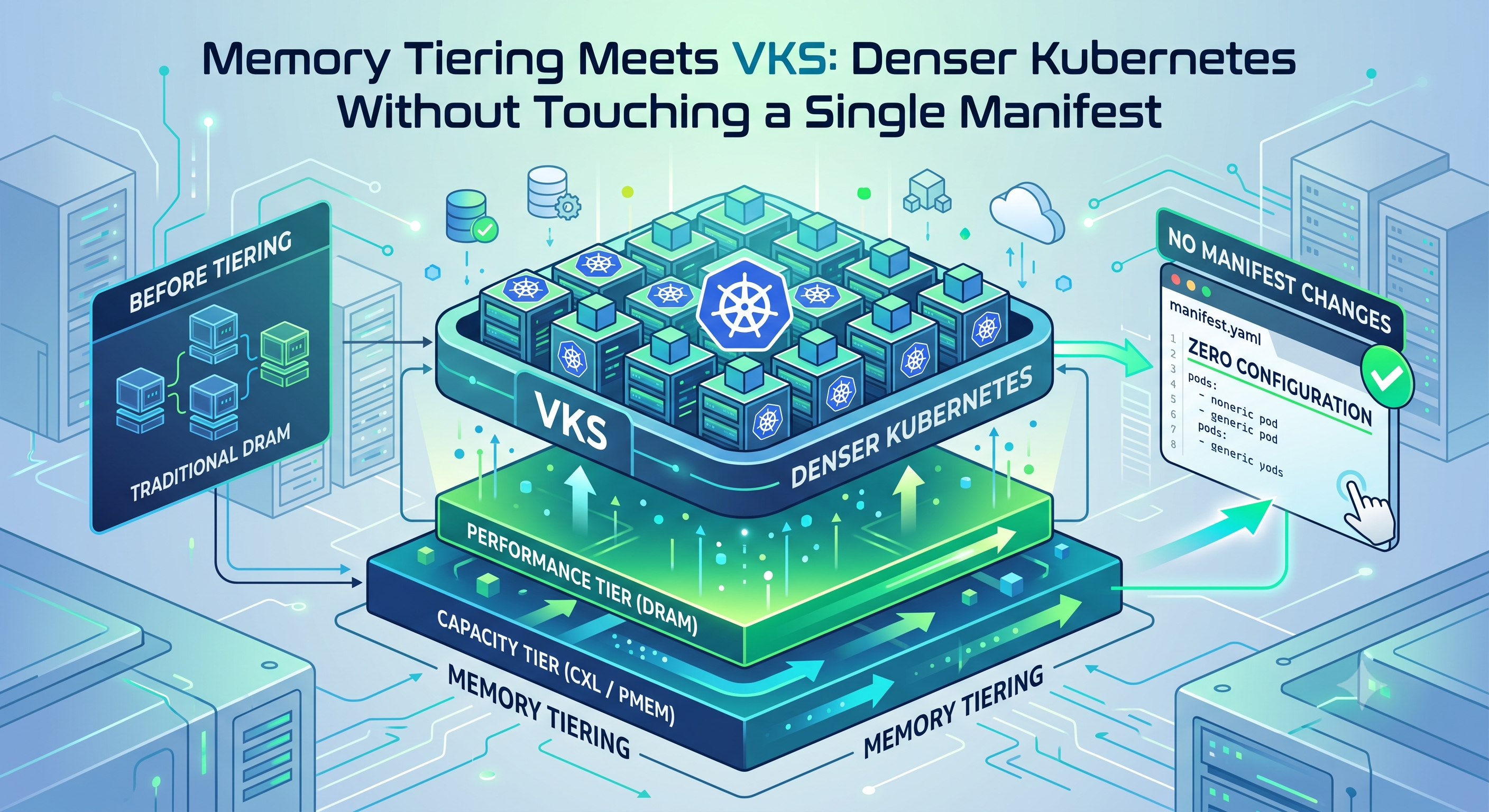
Every so often a platform capability arrives that your workloads benefit from without a single line of configuration. Memory Tiering under vSphere Kubernetes Service (VKS) is exactly that: enable it once at the cluster level, and every Kubernetes node — and every pod on it — inherits smarter memory economics automatically. No drivers, no manifest changes, no separate policy for containers. Broadcom has now published testing that confirms it works for VKS just as well as it does for VMs. Here is what the feature actually does, why the Kubernetes inheritance is the interesting part, and how to put it to work.
- Memory Tiering lets an ESXi host combine DRAM with an NVMe-backed second tier into one memory pool — hot pages stay in DRAM, cold pages move to NVMe, and pages promote back automatically when touched.
- Because VKS worker nodes are VMs on that same hypervisor, Kubernetes inherits the capability transparently — nothing above the hypervisor needs to know it exists.
- The payoff: more worker nodes per host, a smaller DRAM footprint for your Kubernetes estate, and one capacity model that covers VMs and containers together.
- Broadcom’s validation shows VKS workloads on tiered hosts performing in line with VM workloads — so the sizing guidance you already use for VMs extends to Kubernetes with confidence.
- It is a workload-class decision, not a global switch — the “where it fits” section below matters as much as the feature.
The quiet memory problem every Kubernetes platform team knows
Kubernetes schedules pods on requests, and requests are set defensively. The app team asked for 4 GiB “to be safe,” the Helm default was generous, and nobody wants to own the OOMKill. Multiply that across hundreds of pods and every production cluster carries a wide gap between the memory workloads reserve and the memory they actually touch. Platform teams fight this with rightsizing dashboards and VPA recommendations — worthy work that never quite ends, because it treats the symptom: the reservation. The reserved-but-cold memory itself still sits in expensive DRAM.
What if the infrastructure could simply handle cold memory differently from hot memory — without Kubernetes, the node OS, or the application having to participate?
What Memory Tiering actually does
Memory Tiering in VCF 9 lets an ESXi host present a single memory pool built from two tiers: fast DRAM and an NVMe device configured as a memory extension. The hypervisor watches page access patterns and manages placement automatically:
- Hot pages stay in DRAM. Actively-touched memory lives where latency matters.
- Cool pages move to the NVMe tier. Reserved-but-idle memory stops occupying your most expensive resource.
- Touched pages promote back. If a cooled page becomes active again, it returns to DRAM — the process is continuous and automatic.
The crucial design point is where this happens: below the guest OS, below the Kubernetes node VM, below the container runtime. The workload sees one contiguous memory space. There is no driver to install, no kernel parameter to tune, and no application change required. And the economics follow naturally — enterprise NVMe capacity costs a fraction of DRAM per gigabyte, and NVMe bays are plentiful where DIMM slots are finite.
The VKS part: inheritance for free
Here is the architectural elegance that makes this a Kubernetes story. A VKS worker node is a VM running on the same vSphere infrastructure as everything else. So when you enable Memory Tiering on a VCF cluster, your Kubernetes nodes inherit it the moment they land there — exactly as your VMs do. The Kubernetes scheduler keeps making its decisions against each node’s advertised capacity, exactly as before. ESXi, underneath, manages page temperature. Kubernetes manages reservations; the hypervisor manages reality. Each layer does the job it is best at, and neither needs to know about the other.
Contrast that with what this would take anywhere else: per-node OS tuning, kernel-version dependencies, careful coordination with the container runtime, and a Kubernetes-specific memory policy to maintain forever. Under VKS it is one setting, applied at the infrastructure layer, covering your entire fleet — VMs and clusters alike.
The fair question has always been whether the container layer changes the story — Kubernetes workloads are dense, churny, and allocation-happy. Broadcom put exactly that question to the test in their July 2026 post Memory Tiering for VMs and VKS, running database benchmarks on tiered hosts with half the DRAM of the baseline. The finding that matters: VKS workloads performed in line with the equivalent VM workloads, staying close to the full-DRAM baseline within the published sizing guidance. The Kubernetes layer neither breaks nor degrades the feature. Their numbers and test parameters are in the post, with deeper sizing detail in the Memory Tiering performance whitepaper.
The picture
How it helps: four practical wins
1. More worker nodes per host, without buying DRAM. Memory — not CPU — is the binding constraint on most Kubernetes host density. Tiering raises the addressable memory per host using NVMe capacity, which means more (or larger) worker VMs on the same hardware. Your cold-page-rich container estate is precisely the workload profile this was built for: hundreds of defensively-sized pods generate exactly the reserved-but-idle memory that tiers gracefully.
2. A smaller DRAM footprint for the same Kubernetes estate. Flip the same coin: instead of packing more onto big hosts, run the estate you have on hosts with less DRAM. That matters most where DIMM slots are the constraint — edge sites, dense chassis, or refresh cycles where high-capacity DIMMs dominate the bill of materials. Because VCF licensing is per-core, capacity gained through memory density adds nothing to the software line — a point worth one sentence in any business case, even a feature-focused one.
3. One capacity model for VMs and containers. This is the quietly valuable one for platform teams. Broadcom’s validation means the sizing and tiering guidance you use for VM workloads extends to VKS workloads — one set of recommendations, one configuration, one capacity plan for a mixed fleet. No Kubernetes-specific memory policies to author, document, and maintain alongside your VM standards.
4. Zero change to the things you least want to touch. No application code, no container images, no Kubernetes manifests, no node OS tuning. For a platform team, features that require app-team cooperation move at the speed of your slowest app team; features that live below the stack move at the speed of a maintenance window. This one lives below the stack.
Where it fits — and where it doesn’t
An honest feature guide names the boundaries. Memory Tiering is a workload-class decision:
- Hot working sets don’t tier. The benefit comes from cold pages. In-memory databases, Redis, Kafka page cache, JVM heaps under sustained load — workloads that touch most of what they allocate — keep their pages in DRAM, and tiering buys little on those nodes. Plan node pools accordingly rather than expecting uniform gains everywhere.
- Latency-critical pods deserve DRAM guarantees. A page served from NVMe is fast by storage standards and slow by memory standards. Keep tail-latency-sensitive services on untiered or conservatively tiered hosts, and steer them there with the taints and node selectors you already use — your existing Kubernetes scheduling machinery is exactly the right control surface.
- Respect the published guardrail. The official guidance keeps active memory comfortably within DRAM capacity — the working set, not the addressable total, is your design boundary. Start with conservative tier ratios, observe real page-temperature behavior, then extend.
- It complements rightsizing; it doesn’t replace it. Tiering does not change what the Kubernetes scheduler sees — which is the point — but that also means inflated requests still strand schedulable capacity. Keep the rightsizing hygiene; let tiering absorb what hygiene can’t reach.
A practical adoption path
| Step | Action | Output |
|---|---|---|
| 1 | Baseline active vs. consumed memory across VKS clusters in VCF Operations | Your cold-memory opportunity, quantified |
| 2 | Classify node pools: tiering-friendly (stateless services, batch, CI, dev/test) vs. DRAM-guaranteed (data services, latency-critical) | A node-pool map, enforced with taints and labels |
| 3 | Enable tiering on one tiering-friendly host group at a conservative ratio | Real page-temperature data from your workloads |
| 4 | Validate application SLOs and node stability through a full business cycle | Go/no-go evidence per workload class |
| 5 | Extend host group by host group, re-baselining as you go | A fleet-wide rollout grounded in your own data |
The bottom line
The strongest features are the ones your workloads don’t have to know about. Memory Tiering under VKS is a hypervisor capability that Kubernetes inherits simply by running where it runs — hot pages in DRAM, cold pages on NVMe, everything transparent above the hypervisor line. For platform teams it means denser hosts or leaner DRAM configurations, one capacity model across VMs and containers, and not a single manifest changed. VKS already removes the operational overhead of running Kubernetes beside your VM estate; Memory Tiering quietly removes a good part of the DRAM overhead of running it at scale.
Start with the baseline in VCF Operations — the gap between active and consumed memory on your clusters is the feature’s opportunity in your environment, measured. Everything after that is a controlled rollout.
Are you running Memory Tiering under VKS yet — or planning to? I would love to hear which workload classes you are tiering first, and what your active-vs-consumed gap looks like in practice. And if there is interest, a tiering-readiness calculator in the style of my other VCF tools might be the natural follow-up.
Leave a Reply