Supervisor and VKS clusters are built using a common Kubernetes distribution core, but their Kubernetes versions are delivered differently. Starting with VCF 9, Supervisor Kubernetes releases are delivered independently of vCenter. You can update the Supervisor version by deploying a release from the Supervisor Content Library. In this blog post, we will walk through the Supervisor update process step by step. Let’s get started!
Create and Configure a Subscribed Content Library for Supervisor Images
For vSphere Supervisor, VMware publishes Supervisor images through a content delivery network (CDN). To enable or upgrade vSphere Supervisor, you can create a Subscribed Content Library that synchronizes with the Supervisor release images.
You can configure the content library in either Immediate or On-Demand synchronization mode. Note that immediate synchronization from the public CDN may require more time and consume additional disk space.
Log in to vCenter as a vSphere administrator.
From the Home menu, select Content Libraries
Click Create
Provide a name for the library (for example, supervisor update library) and click Next.
On the Configure Content Library page, select Subscribed Content Library.
In the Download content section, select the synchronization mode of the content library and click Next
When prompted, accept the SSL certificate thumbprint.The thumbprint will remain stored on your system until the subscribed content library is removed from the inventory
Apply Security Policy click Next
On the Add storage page, select a datastore as a storage location for the content library contents and click Next.
Review the details and click Finish
Assign the content library to the vSphere Supervisor platform
on vCenter go to Home menu, select Supervisor Management
Select Content Distribution.
On the Supervisor Images Library card, click Assign
Select the Content Library that created above and click Assign
The new content library begins synchronizing, which may take some time. After synchronization is complete, the new Supervisor Kubernetes versions included in the images will appear under the Updates tab
Apply Updates
Select the Available Version you want to update to. For example: v1.30.10+vmware.1-fips-vsc9.0.0.0100. ⚠️ Updates must be applied incrementally. You cannot skip versions (e.g., upgrading directly from 1.28 to 1.30). The correct sequence is 1.28 → 1.29 → 1.30.
Select a Supervisor to update and click Apply Updates
The system runs a series of pre-checks to verify the compatibility of the different components against the Supervisor Kubernetes version to which you want to update.
Learn which are the pre-checks that are run before updating the supervisor and how to troubleshoot in case of errors resulting from failed pre-checks, HERE
When the pre-checks are completed successfully, you can update the Supervisor.
Upgrading the VMware vSphere Supervisor service is a critical step in maintaining a secure, stable, and feature-rich VMware Cloud Foundation environment. By following best practices—planning incremental updates, leveraging subscribed content libraries, and validating compatibility at every stage—administrators can ensure minimal downtime while keeping workloads and Kubernetes clusters up to date. Regular Supervisor upgrades not only enhance platform capabilities but also strengthen the foundation for running modern applications, containers, and cloud-native services efficiently and reliably.
In today’s multi-tenant cloud environments, VMware Cloud Foundation Automation(VCFA) offers a robust layered architecture that seamlessly bridges enterprise-grade infrastructure management with developer-ready self-service capabilities.
By clearly separating responsibilities—from VMware Cloud Service Providers who manage the physical and virtual infrastructure, to organization administrators who allocate resources, and finally to developers who consume them—VCFA enables efficient resource governance, operational consistency, and scalability. This structured approach not only supports multi-tenancy and workload isolation but also accelerates innovation by empowering end users to deploy applications and services quickly within well-defined boundaries.
Why Tenant Management Matters?
Tenant management is more than just dividing resources—it’s about ensuring cost efficiency, security, scalability, and compliance in a shared infrastructure. In VCFA, these capabilities allow VMware Cloud Service Providers to maximize utilization without compromising performance or governance for individual tenants.
Key concepts to understand from both the Provider and Tenant perspectives:
Projects
Projects control user access to namespaces and user ownership of provisioned resources. All organizations are created with a default project. The default project is empty and does not have any namespaces or users.
Example: A VMware Cloud Service Provider might assign a dedicated project to each customer department for clearer billing and isolation.
Regions
The Regions page lists all the regions where the organization has a quota in. Organizations can have a quota in one or many regions. Your provider administrator assigns the regional quota to your organization. Quota in a region can come from one or many vSphere Zones within that region.
Example: A global enterprise hosted by a VMware Cloud Service Provider might have quotas in Asia and Europe to ensure low-latency access for local teams.
Namespace Class
Namespace classes are templates for namespace provisioning. These templates can be used to standardize namespace attributes, like utilization limits, reservations, VM classes, storage classes, and content libraries. organizations comes preconfigured with three default namespace classes (small, medium, and large), which are meant to serve as example templates. The only different attributes among these built-in templates are the CPU and Memory limits. Administrators can use these templates as-is or can modify them to suit their needs.
Namespace
Projects are the central construct for organizing and allocating infrastructure resources to tenants or teams. As the organization administrator, you manage and distribute infrastructure by assigning namespaces to projects. When configuring a project, you must add at least one namespace so that users within the project can begin provisioning workloads such as virtual machines, VMware Kubernetes Service (VKS) clusters, or other supported resources. Namespaces act as scoped resource pools, defining limits for CPU, memory, and storage to ensure fair allocation and performance consistency. Each namespace is tied to a Virtual Private Cloud (VPC) and a namespace class, which in turn is associated with at least one zone to determine placement and availability. This structure not only enforces resource governance but also enables automation workflows to deploy consistently within predefined boundaries. All organizations are created with a default project, which is initially empty and contains no namespaces or users, providing a baseline starting point for configuration.
Example: A tenant of a VMware Cloud Service Provider might create separate namespaces for development and production to avoid accidental resource conflicts.
Virtual Private Clouds (VPCs)
A Virtual Private Cloud (VPC) in VMware Cloud Foundation Automation (VCFA) offers an isolated networking environment that can be associated with one or more namespaces. Organizations can create multiple VPCs and assign each to specific namespaces based on workload or isolation requirements.
Each VPC is an independent network and supports three types of IP address spaces, each offering different levels of reachability:
Private CIDRs: These addresses are internal to the VPC and are not routable outside without NAT. They are managed by the VPC administrator and do not need to be globally unique, allowing reuse across multiple VPCs.
TGW Private IP Blocks: These IP blocks are scoped at the organization level and are advertised through the Transit Gateway (TGW) within the organization. Organization admins define these blocks, and project admins can allocate subnets from them for their VPCs. This enables direct communication between VPCs in the same organization using the TGW Private IP space.
External IP Blocks: Managed by the provider admin, these IPs enable outbound access through Source NAT. Organization admins can assign subnets from provider-defined external blocks, giving workloads external connectivity while still using internal addressing.
You can choose to deploy a separate VPC per namespace for stricter isolation, or share a VPC across namespaces where network separation is not required.
Transit Gateways
Each organization has a transit gateway which provides connectivity to the provider gateway within the organization. One or more VPCs are connected to the transit gateway, and that connection is defined by a VPC connectivity profile. Each VPC has connected workloads and a private subnet. SNAT rules translate addresses from this private subnet to a public address in the IP spaces block. This infrastructure enables the organization and its workloads to connect to external networks.
You can view what transit gateways are available to your organization on the Manage & Govern > Networking > Transit Gateways page.
IP Management
Provider can use IP Spaces to manage their IP address allocation needs. IP Spaces provide a structured approach to allocating public IP addresses to different organizations, enabling connectivity to external networks.
An IP space consists of a set of CIDR blocks that are reserved, these CIDRs must be dedicated to and used by organization administrators as they configure services. An IP space can only be IPv4.
Organization administrators can create and manage the private IP blocks within their organization. there tenant can view external IP address blocks assigned to this organization by a provider. You can also create and view private TGW IP address blocks for the entire organization to use. Finally, you can view private VPC IP address blocks that are applicable to specific VPCs.
In essence, VMware Cloud Foundation Automation’s tenant management capabilities provide a structured, role-based framework for organizing projects, namespaces, VPCs, transit gateways, and IP resources. By aligning provider and tenant responsibilities, VMware Cloud Service Providers ensure secure isolation, consistent governance, and streamlined automation—empowering organizations to scale efficiently while maintaining full control over infrastructure and networking resources.
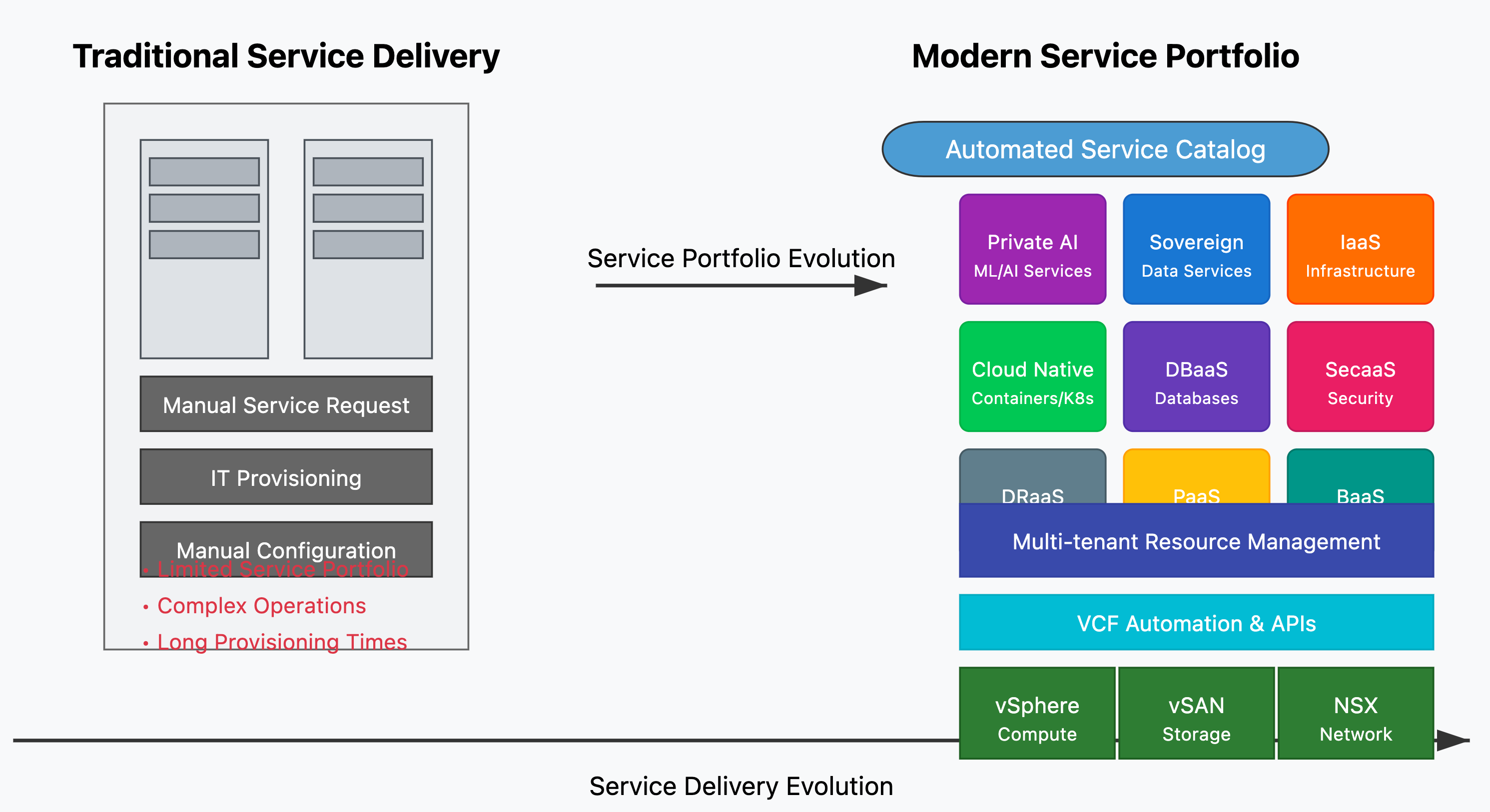
The IT landscape is undergoing a massive transformation. Traditional virtualization, which once revolutionized data centers, is now evolving into full-fledged cloud service delivery. Organizations are no longer just managing VMs; they are delivering scalable, secure, and AI-ready cloud platforms.
The Shift from Virtualization to Cloud Services
Virtualization has been the backbone of IT infrastructure for over a decade, enabling efficiency, consolidation, and improved resource utilization. However, as digital transformation accelerates, enterprises require more than just virtual machines. They need scalable, automated, and AI-powered cloud platforms that can meet the growing demands of modern workloads.
This shift is being powered by VMware Cloud Foundation (VCF)—the cornerstone of modern cloud infrastructure. With VCF, enterprises and Cloud Service Providers (CSPs) can move beyond virtualization to build multi-cloud, hybrid, and sovereign cloud environments with automation, security, and AI-driven capabilities at their core.
Key Benefits of VMware Cloud Foundation
✅ Unified Platform: Compute, storage, networking, and management are integrated into a single solution. ✅ Hybrid & Multi-Cloud Operations: Seamlessly run workloads across private, public, and hybrid cloud environments. ✅ Built-in Security & Compliance: Ensure data sovereignty and regulatory compliance with sovereign cloud initiatives. ✅ AI-Ready Infrastructure: GPU acceleration and private AI capabilities empower AI/ML workloads. ✅ Accelerated Cloud Service Delivery: Enable Cloud Providers & VMware Cloud Service Providers (VCSPs) to deliver next-gen cloud offerings.
The Significance of VMware Cloud Providers (VCSPs)
VMware Cloud Providers (VCSPs) play a pivotal role in enabling organizations to seamlessly transition from virtualization to cloud services. They extend the capabilities of VMware Cloud Foundation by offering:
🔹 Managed Cloud Services: Helping enterprises offload infrastructure management with fully managed VMware-based cloud environments. 🔹 Sovereign and In-Country Cloud Solutions: Ensuring compliance with regional data sovereignty laws while delivering cloud scalability. 🔹 Multi-Tenant Cloud Platforms: Empowering service providers to offer flexible, cost-effective cloud solutions with secure tenant isolation. 🔹 AI and GPU-Powered Cloud Services: Providing enterprises with AI-ready infrastructure to support next-gen workloads. 🔹 Disaster Recovery & Business Continuity: Offering reliable DRaaS (Disaster Recovery as a Service) to ensure business resilience.
Future of Cloud with VMware Cloud Foudation
As enterprises and service providers embrace cloud-first and AI-driven strategies, VCF is enabling them to deliver next-generation cloud services with agility, resilience, and efficiency. This evolution is not just about technology; it’s about unlocking new business opportunities, enhancing innovation, and driving digital transformation at scale.
With cloud-native applications, AI/ML workloads, and security-first cloud strategies becoming the new normal, the role of VMware Cloud Foundation is more critical than ever.
VMware Cloud Foundation is transforming the way cloud services are delivered, from the traditional virtualization model to highly flexible, customer-tailored cloud services. With the support of VCSPs, businesses are empowered to adopt cutting-edge cloud solutions faster and more efficiently than ever before.
In today’s rapidly evolving cloud landscape, integrating robust data management solutions is crucial for maintaining efficiency and scalability. VMware’s Data Services Manager (DSM) offers a comprehensive suite of tools to manage data services, and when integrated with VMware Cloud Director (VCD) and the Data Solutions Extension (DSE), it provides a powerful platform for cloud providers and their tenants. Integrating VMware DSM with VCD and DSE offers several advantages:
Automation: Integration with VCD’s automation capabilities enables streamlined deployment and management of databases.
Self-Service DBaaS: Tenants can easily provision and manage databases like MySQL, PostgreSQL, etc., without admin intervention.
Centralized Management: Service providers maintain full control and visibility over all database services provisioned by tenants.
Scalability: Easily scale database instances as per tenant demand, with seamless multi-tenant support.
Overview of VMware Data Services Manager (DSM)
VMware Cloud Director extension for Data Solutions offers a simple tenant-facing self-service UI for the lifecycle management of data solutions with a single view across multiple instances, and with URL to individual instances for service specific management. Service instances are deployed in the service provider’s VMware Cloud Director-managed VMware vSphere or VMware Tanzu Kubernetes Grid on-premises infrastructure. The full stack – management to individual data services – is VMware-supported and available on a consumption basis. Service providers have a choice to offer VMware Cloud Director extension for Data Solutions as self-service to data-experienced tenant customers, as a managed data service, or as a sovereign cloud data service. This extension widens VMware Cloud Director’s multi-tenant-safe cloud consumption surface to support the following data solutions.
VMware Data Services Manager MySQL
VMware RabbitMQ
VMware SQL with Postgres and VMware SQL with MySQL
Mongo DB Enterprise Advanced and Community editions
Apache Kafka – Confluent Platform
VMware Data Services Manager Postgres
Prerequisites
Before you begin the integration, ensure you have the following:
A deployed VMware Cloud Director instance.
VMware Data Services Manager installed and configured.
A prepared Tanzu Kubernetes Grid (TKG) cluster.
Steps for Integration
Install and Configure VMware DSM
VMware DSM simplifies data services management by offering a platform for tenants to provision, manage, and monitor their databases. Here’s how to set it up:
Deploy DSM:
Deploy the VMware DSM appliance in your VMware environment.
Ensure DSM is connected to your Cloud Director and vSphere environment, with access to required resources for provisioning database instances.
Configure Data Services:
Within DSM, configure the data services you wish to offer to tenants, such as MySQL, PostgreSQL, MongoDB, etc.
Define database service policies, such as backup policies, storage configurations, and high availability options.
Create Tenant-specific Database Templates:
Create database templates or pre-configured service offerings for different tenants, specifying the parameters such as CPU, memory, storage, and network configurations.
For more details on how to setup DSM see – set up the infrastructure policy and backup locations in the VMware Data Services Manager portal, see the VMware Data Services Manager Documentation.
Data Solution Extension Integration with DSM
The VMware Cloud Director Extension for Data Solutions is a powerful plug-in designed to enhance VMware Cloud Director by adding data and messaging services to its portfolio. This extension enables cloud providers to offer a variety of on-demand data services to their tenants, including:
VMware SQL with MySQL
VMware SQL with PostgreSQL
RabbitMQ
Kafka
Mongo DB
Now to Integrate DSE with DSM follow below steps:
Access your VMware Cloud Director instance and navigate to the Data Solutions Extension.
Go to Settings > DSM Integration within the Data Solutions Extension interface
Choose the TKG cluster (this is provider hosted K8s Cluster) where you want to deploy the data services operatorr and click Next.
Follow the prompts to install the Data Solutions operator. This process typically takes a few minutes.
Enter the necessary details to connect VMware DSM with the Data Solutions Extension and click Connect
Define infrastructure policies and backup locations within the VMware DSM portal to ensure data protection and compliance.
Publish to Tenants
Once the integration is complete, you can publish VMware DSM PostgreSQL and MySQL solutions to tenant organizations.
Enter your user name and password, and click Sign In.
In the primary left navigation panel, click More > Data Solutions.
Select version required and enter required details to deploy a database
Tenant Self Service – Backup/Restore
You can protect your data solution instances by backing them up to an S3 location and restoring them to a new instance
You can backup solution instances on-demand or by using a custom backup schedule. You can back up and restore VMware SQL with Postgres, VMware SQL with MySQL, VMware Data Services Manager MySQL, and VMware Data Services Manager Postgres instances.
Tenant Self Service – Upgrade
You can upgrade the available data solutions and their instances within the VMware Cloud Director extension for Data Solutions.
Upgrade a solution
Select the upgrade version and Acknowledge that you have read and completed the pre-upgrade actions and click Upgrade.
Integrating VMware Data Services Manager with VMware Cloud Director and the Data Solutions Extension is a strategic move for cloud providers looking to enhance their service offerings. By following the steps outlined above, you can streamline your data management processes, improve scalability, and deliver a superior experience to your tenants.
As businesses’ cloud strategies evolve, many are reconsidering their reliance on public cloud environments and exploring the benefits of private cloud solutions. Public clouds like AWS, Azure, and Google Cloud offer flexibility and scalability, but they also come with challenges such as unpredictable costs, security concerns, and limited control. This is where VMware Cloud Service Providers (CSPs), powered by VMware Cloud Foundation (VCF), present a compelling alternative for businesses looking to transition from public to private cloud. Here’s why customers should choose a VMware CSP when making this move:
1. Predictable Costs and Better Financial Control
Public Cloud Challenge: The pay-as-you-go model of public clouds is attractive at first but often leads to unpredictable and escalating costs. Usage spikes, data transfer fees, and networking costs can cause budget overruns, making it difficult for businesses to manage long-term financial planning.
VMware CSP Advantage: With VMware Cloud Foundation hosted by a VMware CSP, costs become more predictable and fixed. Unlike public clouds, where charges can fluctuate based on consumption, VMware CSPs offer stable pricing tailored to the customer’s dedicated infrastructure needs. This leads to greater financial control and ensures that businesses can plan their budgets with confidence, avoiding unexpected bills and cost surges.
2. Enhanced Security and Compliance
Public Cloud Challenge: While public cloud providers maintain infrastructure security, customers are responsible for securing their data. This shared responsibility model introduces potential security gaps, especially in multi-tenant environments where data is more exposed. For industries with strict regulatory requirements, such as healthcare and finance, managing compliance in a public cloud can be challenging.
VMware CSP Advantage: VMware Cloud Service Providers offer private, dedicated infrastructure, giving businesses full control over their security protocols. VMware Cloud Foundation includes built-in features like NSX micro-segmentation, end-to-end encryption, and automated compliance controls to ensure robust security. This infrastructure meets the stringent security needs of industries like government and financial services, making it easier for organizations to comply with regulations such as GDPR, HIPAA, and PCI-DSS.
By choosing a VMware CSP, businesses can deploy their own security policies and governance measures, ensuring full compliance without the risks associated with public cloud environments.
3. Consistent Performance and Infrastructure Customization
Public Cloud Challenge: Public clouds are designed to serve a broad range of customers, leading to performance variability. The shared, multi-tenant nature of public clouds can cause resource contention, which negatively impacts performance for businesses with mission-critical workloads. Additionally, public cloud platforms offer limited options for customizing infrastructure to optimize specific workloads.
VMware CSP Advantage: With a VMware CSP, businesses gain access to dedicated infrastructure that provides consistent, reliable performance. VMware Cloud Foundation allows companies to customize their private cloud environments, tuning resources to meet the exact demands of high-performance workloads like AI/ML, enterprise applications, or data-intensive tasks. This ensures optimal performance and avoids the unpredictable resource contention seen in public cloud environments.
4. Full Control Over Data and Infrastructure
Public Cloud Challenge: In a public cloud setup, businesses often lose a degree of control over their data and infrastructure, as public cloud providers manage the underlying systems. This can lead to vendor lock-in, where organizations are restricted to the cloud provider’s tools and architecture, making it difficult to adapt or migrate workloads.
VMware CSP Advantage: VMware Cloud Foundation offers businesses full control over their infrastructure, ensuring flexibility and freedom. With a VMware CSP, organizations are not bound by the limitations of a public cloud vendor’s ecosystem. Instead, they can manage and operate their private cloud environment according to their own policies and tools, retaining ownership of their data and ensuring it is managed and stored in compliance with their internal standards.
Moreover, VMware CSPs provide a vendor-neutral platform, reducing the risk of cloud lock-in and enabling smoother transitions to other cloud models if needed.
5. Simplified Compliance and Data Residency
Public Cloud Challenge: Many businesses must comply with strict regulations around data residency and sovereignty, requiring data to be stored and processed within specific regions. While public clouds offer region-based services, maintaining compliance can be complex due to the global nature of their infrastructure and multi-tenant environments.
VMware CSP Advantage: VMware Cloud Service Providers offer private cloud environments where data residency is easily enforced, ensuring that sensitive information remains within required geographic boundaries. Organizations can select specific data center locations that comply with local laws and regulatory requirements, providing greater control over data governance. This is crucial for industries like finance, healthcare, and government, where compliance and data sovereignty are paramount.
6. Hybrid and Multi-Cloud Flexibility
Public Cloud Challenge: Public clouds are optimized for running workloads within their own ecosystem, making hybrid or multi-cloud strategies more complex. This often results in vendor lock-in, where businesses are limited to the services and infrastructure of a single cloud provider.
VMware CSP Advantage: VMware Cloud Foundation is designed for hybrid and multi-cloud environments, offering businesses the flexibility to run workloads across private clouds, on-premises infrastructure, and public clouds (via VMware Cloud on AWS, Azure VMware Solution, or Google Cloud VMware Engine). This allows businesses to choose the best environment for each workload while maintaining a consistent management experience across clouds. VMware CSPs provide the best of both worlds, enabling seamless hybrid cloud operations without sacrificing control or flexibility.
7. Long-Term Cost Efficiency and Lower Total Cost of Ownership (TCO)
Public Cloud Challenge: Public clouds are ideal for elastic workloads but can become costly for steady-state or predictable workloads. Over time, businesses may find that public cloud environments become less efficient, with resources underutilized or costs outpacing usage.
VMware CSP Advantage: Private clouds hosted by VMware CSPs offer a more cost-efficient solution for businesses with predictable workloads. By shifting to a fixed-cost private cloud model, organizations avoid the long-term costs of over-provisioning in the public cloud. VMware Cloud Foundation optimizes resource utilization, ensuring infrastructure is used efficiently, leading to a lower total cost of ownership (TCO) over time.
For enterprises looking to stabilize their operational costs while maintaining cloud-level flexibility, VMware CSPs provide a long-term financial advantage compared to public cloud platforms.
Conclusion
Transitioning from public cloud to a private cloud environment hosted by a VMware Cloud Service Provider offers businesses a powerful combination of predictable costs, enhanced security, control, and customized infrastructure. VMware CSPs allow organizations to regain control over their data and operations, ensure compliance with stringent regulatory requirements, and optimize performance for mission-critical applications.
For enterprises seeking a strategic balance between cloud agility and operational control, VMware Cloud Service Providers are the ideal partners to support a seamless and effective move from public cloud to private cloud.
In today’s dynamic business environment, enterprises are increasingly seeking agile and scalable private cloud solutions. VMware partners are uniquely positioned to capitalize on this trend, and vSAN, VMware’s software-defined storage solution, is a powerful tool to add to your private cloud arsenal. Let’s delve into why vSAN, with its new licensing model and advanced architecture, is a strategic asset for building compelling private cloud offerings.
The Private Cloud Imperative
Organizations are looking to migrate to private clouds ( on prem or partner hoststed or partner managed ) to gain greater control, flexibility, and security over their IT infrastructure. Private clouds offer several advantages:
Security and Compliance: Maintain control over data and applications within a secure, private environment.
Improved Resource Utilization: Consolidate resources and eliminate silos, leading to more efficient allocation and utilization.
Enhanced Agility: Rapidly provision and scale resources to meet changing business demands.
vSAN: The Bedrock of a Robust Private Cloud
vSAN plays a critical role in building a feature-rich private cloud solution. Here’s how it empowers partners with a new licensing model and advanced architecture:
Simplified Infrastructure Management: vSAN integrates seamlessly with existing VMware tools, streamlining provisioning, deployment, and management of private cloud infrastructure.
Scalability on Demand: Effortlessly scale storage and compute resources within your private cloud to accommodate business growth.
Reduced Operational Costs: The software-defined nature of vSAN eliminates the need for expensive, dedicated storage hardware, leading to significant cost savings.
New vSAN Licensing Model: The recent shift to a per-core consumption model offers predictable pricing (VCF provides 1 TiB of vSAN entitlement for each VCF core purchased), allowing you to accurately forecast costs and deliver competitive private cloud solutions.
vSAN Express Storage Architecture (ESA): The ESA is optimized to exploit the full potential of the very latest in hardware and unlocks new capabilities, simplifies deployment and streamlines management for private cloud environments.
Power of ESA
The Express Storage Architecture in vSAN 8 stands on the shoulders of much of the architecture found in OSA included in previous versions of vSAN, and vSAN 8. vSAN had already solved many of the great challenges associated with distributed storage systems, and we wanted to build off of these capabilities while looking at how best to optimize a data path to reflect the capabilities of today’s hardware.
The advances in architecture primarily come from two areas, as illustrated in below figure:
An optimized log-structured object manager and data structure. This layer is a new design built around a new high-performance block engine and key value store that can deliver large write payloads while minimizing the overhead needed for metadata. The new design was built specifically for the capabilities of the highly efficient upper layers of vSAN to send data to the devices without contention. It is highly parallel and helps us drive near device-level performance capabilities in the ESA.
A new patented log-structured file system. This new layer in the vSAN stack – known as the vSAN LFS – allows vSAN to ingest new data fast and efficiently while preparing the data for a very efficient full stripe write. The vSAN LFS also allows vSAN to store metadata in a highly efficient and scalable manner.
vSAN Max is a distributed scale-out storage system for vSphere clusters. It is powered by the vSAN ESA, so it offers the capabilities that are a part of the ESA, but serves as a storage-only cluster. It uses vSAN’s native protocol and data path for cross-cluster communication, which preserves the management experience and provides the highest levels of performance and flexibility for a distributed storage system.
vSAN offers more than just operational benefits. Here’s how it elevates your private cloud proposition:
Faster Time to Market: The rapid deployment capabilities of vSAN, allow you to deliver private cloud solutions to clients quickly and efficiently.
Improved Service Delivery: vSAN’s inherent performance and scalability, coupled with vSAN MAX for demanding workloads, enable you to offer high-performance private cloud environments for any customer need.
Enhanced Security: vSAN integrates with VMware security features, allowing you to build private clouds that meet stringent security compliance requirements.
Partnering for Private Cloud Success
To maximize your success with vSAN in the private cloud domain or VMware based public cloud domain, consider these steps:
Develop Private Cloud Expertise: Invest in training and resources to build a team of experts proficient in designing, deploying, and managing private cloud solutions with vSAN, including the new licensing model and vSAN ESA architecture.
Craft Compelling Private Cloud Packages: Develop standardized or customizable private cloud packages that leverage vSAN’s strengths to address specific customer needs, including options for cost-optimized vSAN configurations or high-performance vSAN MAX deployments.
Showcase Customer Success Stories: Demonstrate the value proposition of vSAN-powered private clouds through successful client case studies and testimonials, highlighting the benefits of the new licensing model, vSAN ESA, and vSAN MAX for diverse private cloud requirements.
Conclusion
VMware partners have a tremendous opportunity to lead the private cloud charge. By embracing VMware vSAN, its new licensing model, advanced vSAN ESA architecture, and the power of vSAN MAX, you can empower businesses to thrive in the digital age. Invest in vSAN expertise, craft compelling private cloud offerings, and watch your business soar as a trusted advisor in the private cloud revolution.