In today’s rapidly evolving cloud landscape, integrating robust data management solutions is crucial for maintaining efficiency and scalability. VMware’s Data Services Manager (DSM) offers a comprehensive suite of tools to manage data services, and when integrated with VMware Cloud Director (VCD) and the Data Solutions Extension (DSE), it provides a powerful platform for cloud providers and their tenants. Integrating VMware DSM with VCD and DSE offers several advantages:
Automation: Integration with VCD’s automation capabilities enables streamlined deployment and management of databases.
Self-Service DBaaS: Tenants can easily provision and manage databases like MySQL, PostgreSQL, etc., without admin intervention.
Centralized Management: Service providers maintain full control and visibility over all database services provisioned by tenants.
Scalability: Easily scale database instances as per tenant demand, with seamless multi-tenant support.
Overview of VMware Data Services Manager (DSM)
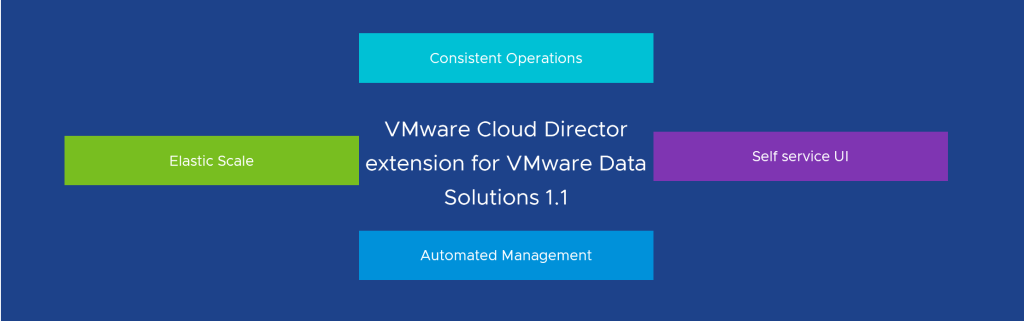
VMware Cloud Director extension for Data Solutions offers a simple tenant-facing self-service UI for the lifecycle management of data solutions with a single view across multiple instances, and with URL to individual instances for service specific management. Service instances are deployed in the service provider’s VMware Cloud Director-managed VMware vSphere or VMware Tanzu Kubernetes Grid on-premises infrastructure. The full stack – management to individual data services – is VMware-supported and available on a consumption basis. Service providers have a choice to offer VMware Cloud Director extension for Data Solutions as self-service to data-experienced tenant customers, as a managed data service, or as a sovereign cloud data service. This extension widens VMware Cloud Director’s multi-tenant-safe cloud consumption surface to support the following data solutions.
VMware Data Services Manager MySQL
VMware RabbitMQ
VMware SQL with Postgres and VMware SQL with MySQL
Mongo DB Enterprise Advanced and Community editions
Apache Kafka – Confluent Platform
VMware Data Services Manager Postgres
Prerequisites
Before you begin the integration, ensure you have the following:
A deployed VMware Cloud Director instance.
VMware Data Services Manager installed and configured.
A prepared Tanzu Kubernetes Grid (TKG) cluster.
Steps for Integration
Install and Configure VMware DSM
VMware DSM simplifies data services management by offering a platform for tenants to provision, manage, and monitor their databases. Here’s how to set it up:
Deploy DSM:
Deploy the VMware DSM appliance in your VMware environment.
Ensure DSM is connected to your Cloud Director and vSphere environment, with access to required resources for provisioning database instances.
Configure Data Services:
Within DSM, configure the data services you wish to offer to tenants, such as MySQL, PostgreSQL, MongoDB, etc.
Define database service policies, such as backup policies, storage configurations, and high availability options.
Create Tenant-specific Database Templates:
Create database templates or pre-configured service offerings for different tenants, specifying the parameters such as CPU, memory, storage, and network configurations.
For more details on how to setup DSM see – set up the infrastructure policy and backup locations in the VMware Data Services Manager portal, see the VMware Data Services Manager Documentation.
Data Solution Extension Integration with DSM
The VMware Cloud Director Extension for Data Solutions is a powerful plug-in designed to enhance VMware Cloud Director by adding data and messaging services to its portfolio. This extension enables cloud providers to offer a variety of on-demand data services to their tenants, including:
VMware SQL with MySQL
VMware SQL with PostgreSQL
RabbitMQ
Kafka
Mongo DB
Now to Integrate DSE with DSM follow below steps:
Access your VMware Cloud Director instance and navigate to the Data Solutions Extension.
Go to Settings > DSM Integration within the Data Solutions Extension interface
Choose the TKG cluster (this is provider hosted K8s Cluster) where you want to deploy the data services operatorr and click Next.
Follow the prompts to install the Data Solutions operator. This process typically takes a few minutes.
Enter the necessary details to connect VMware DSM with the Data Solutions Extension and click Connect
Define infrastructure policies and backup locations within the VMware DSM portal to ensure data protection and compliance.
Publish to Tenants
Once the integration is complete, you can publish VMware DSM PostgreSQL and MySQL solutions to tenant organizations.
Enter your user name and password, and click Sign In.
In the primary left navigation panel, click More > Data Solutions.
Select version required and enter required details to deploy a database
Tenant Self Service – Backup/Restore
You can protect your data solution instances by backing them up to an S3 location and restoring them to a new instance
You can backup solution instances on-demand or by using a custom backup schedule. You can back up and restore VMware SQL with Postgres, VMware SQL with MySQL, VMware Data Services Manager MySQL, and VMware Data Services Manager Postgres instances.
Tenant Self Service – Upgrade
You can upgrade the available data solutions and their instances within the VMware Cloud Director extension for Data Solutions.
Upgrade a solution
Select the upgrade version and Acknowledge that you have read and completed the pre-upgrade actions and click Upgrade.
Integrating VMware Data Services Manager with VMware Cloud Director and the Data Solutions Extension is a strategic move for cloud providers looking to enhance their service offerings. By following the steps outlined above, you can streamline your data management processes, improve scalability, and deliver a superior experience to your tenants.
In today’s dynamic business environment, enterprises are increasingly seeking agile and scalable private cloud solutions. VMware partners are uniquely positioned to capitalize on this trend, and vSAN, VMware’s software-defined storage solution, is a powerful tool to add to your private cloud arsenal. Let’s delve into why vSAN, with its new licensing model and advanced architecture, is a strategic asset for building compelling private cloud offerings.
The Private Cloud Imperative
Organizations are looking to migrate to private clouds ( on prem or partner hoststed or partner managed ) to gain greater control, flexibility, and security over their IT infrastructure. Private clouds offer several advantages:
Security and Compliance: Maintain control over data and applications within a secure, private environment.
Improved Resource Utilization: Consolidate resources and eliminate silos, leading to more efficient allocation and utilization.
Enhanced Agility: Rapidly provision and scale resources to meet changing business demands.
vSAN: The Bedrock of a Robust Private Cloud
vSAN plays a critical role in building a feature-rich private cloud solution. Here’s how it empowers partners with a new licensing model and advanced architecture:
Simplified Infrastructure Management: vSAN integrates seamlessly with existing VMware tools, streamlining provisioning, deployment, and management of private cloud infrastructure.
Scalability on Demand: Effortlessly scale storage and compute resources within your private cloud to accommodate business growth.
Reduced Operational Costs: The software-defined nature of vSAN eliminates the need for expensive, dedicated storage hardware, leading to significant cost savings.
New vSAN Licensing Model: The recent shift to a per-core consumption model offers predictable pricing (VCF provides 1 TiB of vSAN entitlement for each VCF core purchased), allowing you to accurately forecast costs and deliver competitive private cloud solutions.
vSAN Express Storage Architecture (ESA): The ESA is optimized to exploit the full potential of the very latest in hardware and unlocks new capabilities, simplifies deployment and streamlines management for private cloud environments.
Power of ESA
The Express Storage Architecture in vSAN 8 stands on the shoulders of much of the architecture found in OSA included in previous versions of vSAN, and vSAN 8. vSAN had already solved many of the great challenges associated with distributed storage systems, and we wanted to build off of these capabilities while looking at how best to optimize a data path to reflect the capabilities of today’s hardware.
The advances in architecture primarily come from two areas, as illustrated in below figure:
An optimized log-structured object manager and data structure. This layer is a new design built around a new high-performance block engine and key value store that can deliver large write payloads while minimizing the overhead needed for metadata. The new design was built specifically for the capabilities of the highly efficient upper layers of vSAN to send data to the devices without contention. It is highly parallel and helps us drive near device-level performance capabilities in the ESA.
A new patented log-structured file system. This new layer in the vSAN stack – known as the vSAN LFS – allows vSAN to ingest new data fast and efficiently while preparing the data for a very efficient full stripe write. The vSAN LFS also allows vSAN to store metadata in a highly efficient and scalable manner.
vSAN Max is a distributed scale-out storage system for vSphere clusters. It is powered by the vSAN ESA, so it offers the capabilities that are a part of the ESA, but serves as a storage-only cluster. It uses vSAN’s native protocol and data path for cross-cluster communication, which preserves the management experience and provides the highest levels of performance and flexibility for a distributed storage system.
vSAN offers more than just operational benefits. Here’s how it elevates your private cloud proposition:
Faster Time to Market: The rapid deployment capabilities of vSAN, allow you to deliver private cloud solutions to clients quickly and efficiently.
Improved Service Delivery: vSAN’s inherent performance and scalability, coupled with vSAN MAX for demanding workloads, enable you to offer high-performance private cloud environments for any customer need.
Enhanced Security: vSAN integrates with VMware security features, allowing you to build private clouds that meet stringent security compliance requirements.
Partnering for Private Cloud Success
To maximize your success with vSAN in the private cloud domain or VMware based public cloud domain, consider these steps:
Develop Private Cloud Expertise: Invest in training and resources to build a team of experts proficient in designing, deploying, and managing private cloud solutions with vSAN, including the new licensing model and vSAN ESA architecture.
Craft Compelling Private Cloud Packages: Develop standardized or customizable private cloud packages that leverage vSAN’s strengths to address specific customer needs, including options for cost-optimized vSAN configurations or high-performance vSAN MAX deployments.
Showcase Customer Success Stories: Demonstrate the value proposition of vSAN-powered private clouds through successful client case studies and testimonials, highlighting the benefits of the new licensing model, vSAN ESA, and vSAN MAX for diverse private cloud requirements.
Conclusion
VMware partners have a tremendous opportunity to lead the private cloud charge. By embracing VMware vSAN, its new licensing model, advanced vSAN ESA architecture, and the power of vSAN MAX, you can empower businesses to thrive in the digital age. Invest in vSAN expertise, craft compelling private cloud offerings, and watch your business soar as a trusted advisor in the private cloud revolution.
VMware Cloud Director OIDC Integration with VMware Workspace ONE Access
Prerequisite
VMware Workspace access ONE must be already deployed.
VMware workspace access ONE must be configured with a directory service source for users and groups.
Cloud Director must be installed and configured for provider and tenant organizations.
Bill of Material
VMware Cloud Director 10.5.1
VMware Workspace ONE Access 23.09.00
Steps to Configure Workspace ONE Access for OIDC Authentication
Workspace ONE Access uses OAuth 2 to enable applications to register with Workspace ONE Access and create secure delegated access to applications. In this case, we will use Cloud Director to integrate with Workspace One Access.
In the Workspace ONE Access console Settings>OAuth 2.0Management page, click ADD CLIENT.
In the Add Clientpage, configure the following.
Label
Description
Access Type
Set to User Access Token
Client ID
Enter a unique client identifier for the Cloud Director Organization (System/Tenant)
Grant Type
Authorization Code Grant – When you select Authorization Code Grant, the Redirect URI setting is displayed under Grant Type. Refresh Token Grant – is enabled by default when the Issue refresh token setting is enabled. If you deactivate Issue refresh token, the Refresh Token Grant type is not checked.
Redirect URI
Retrieve this from VCD Provider/Tenant portal at: https://[VCD Endpoint]/(provider or tenant/[orgname])/administration/identity-providers/oidcSettings
Scope
The scope defines which part of the user’s account the token can access. The scopes you can select from include Email, Profile, User, NAPPS, OpenID, Group, and Admin.
Issue refresh token
To allow for the return of a refresh token, leave this option enabled.
Refresh token TTL
Set the Refresh Token time to live value. New access tokens can be requested until the refresh token expires.
Access token TTL
The access token expires in the number of seconds set in Access Token TTL. If Issue Refresh Token is enabled, when the access token expires, the application uses the refresh token to request a new access token.
Idle Token TTL
Configure how long a refresh token can be idle before it cannot be used again.
Token Type
For Workspace ONE Access, the token type is Bearer Token.
User Grant
Prompt users for scope acceptance is disabled. If Enabled users are shown message that lists the scopes that are being sent.
Click SAVE. The client page is refreshed and the Client ID and the hidden Shared Secret are displayed.
Copy and save the client ID and generated shared secret.
Note: If the shared secret is not saved or you lose the secret code, you must generate a new secret, and update in Cloud Director that uses the same shared secret with the regenerated secret. To regenerate a secret, click the client ID that requires a new secret from the OAuth 2.0 Management page and click REGENERATE SECRET.
Steps to configure VMware Cloud Director to use Workspace ONE Access for Provider/Tenant users and groups
From the top navigation bar, select Administration.
In the left panel, under Identity Providers, click OIDC or directly you can browse: https:// [VCD Endpoint]/(provider or tenant/[orgname])/administration/identity-providers/oidcSettings
If you are configuring OIDC for the first time, copy the client configuration redirect URI and use it to create a client application registration with an identity provider that complies with the OpenID Connect standard, for example, VMware Workspace ONE Access. (this has already been done above)
Click Configure
Verify that OpenID Connect is active and fill in the Client ID and Client Secret you created in VMware Workspace ONE Access as above during client creation.
To use the information from a well-known endpoint to automatically fill in the configuration information, turn on the Configuration Discovery toggle and enter a URL at the site of the provider that VMware Cloud Director can use to send authentication requests to. Fill in the IDP Well-known Configuration Endpoint field with the value: https://ws01 URL/SAAS/auth/.well-known/openid-configuration
Click next.
If everything is correctly configured, the below information will automatically get populated, keep a note we are using the User Info endpoint.
VMware Cloud Director uses the scopes to authorize access to user details. When a client requests an access token, the scopes define the permissions that this token has to access user information, enter the scope information, and clickNext.
Since we are using User Info as an access type, map the claims as below and click Next.
NOTE: At the claims mapping step, the Subject theme will be default populated with “sub” which will mean that VCD users will have the username format “[username]@XXX”. If you want to import the users to VCD with a different format, you can change the Subject theme to map to “email” and then import users to VCD using the email address attached to the account.
This is the most critical piece of configuration. Mapping this information is essential for VCD to interpret the token/user information correctly during the login process.
Login as an OIDC GROUP Member User
In the Provider/Tenant organization’s Administration Page, import OIDC groups and map them to existing VCD roles.
NOTE: In case you don’t see the “IMPORT GROUPS” button, refresh the page, and you will see the desired button IMPORT GROUPS
User go to https:// [VCD Endpoint]/(provider or tenant/[orgname])
The user should be redirected to the Workspace ONE Access login page. Users can log in with the user in the group.
The user will be redirected back to VCD and should now be fully logged in.
After the first successful login, the organization administrator can see the newly auto-imported user.
Login as an OIDC User
In the Provider/Tenant organization’s Administration Page, import OIDC users and map them to existing VCD roles.
The user should be redirected to the Workspace ONE Access login page and log in there.
The user will be redirected back to VCD and should now be fully logged in.
If you get the SSO Failure page double-check that you imported to the correct group/user and that the username format is correct. For additional information, you can check Here and for troubleshooting and about configuring additional logging, you can check the official documentation here.
Multi-Tenancy was introduced in NSX UI starting from VMware NSX 4.1 and now commencing with version 10.5.1, VMware Cloud Director introduces support for NSX multi-tenancy, facilitating direct alignment of vcd organizations with NSX projects.
What are NSX Projects ?
A project in NSX functions akin to a tenant. Creating projects enables the separation of security and networking configurations among different tenants within a single NSX setup.
Multi-tenancy in NSX is achieved by creating NSX projects, where each project represents a logical container of network and security resources (a tenant). Each project can have its set of users, assigned privileges, and quotas. Multi-tenancy serves various purposes, such as providing Networking as a Service, Firewall as a Service, and more.
How NSX Projects relate to Cloud Director Organizations?
Within the VCD platform, the tenancy is established via Organizations. Each tenant receives its exclusive organization, ensuring a distinct and isolated virtual infrastructure tailored to their tasks. This organizational setup grants precise control over tenant access to resources, empowering them to oversee Users, Virtual Data Centers (VDCs), Catalogs, Policies, and other essentials within their domain.
To clearly outline the tenant structure, VMware NSX introduced a feature known as Projects. These Projects allocate NSX users to distinct environments housing their specific objects, configurations, and monitoring mechanisms based on alarms and logs.
With VCD 10.5.1, management functionalities tied to NSX Tenancy fall within the exclusive purview of the Provider. NSX Tenancy operates on an Organization-specific level within VCD. When activated, a VCD Organization aligns directly with an NSX Project.
VCD drives and manages the creation of the associated NSX project, allowing the User to configure the project identifier. The NSX project is actually created during the creation of the first VDC in the organization for which you activated NSX tenancy. The name of the NSX project is the same as the name of the organization to which it is mapped.
How to enable?
The Cloud Provider can enable the NSX Tenancy for a specific Organization by going into the Cloud Director Organization section, choosing an organization, and selecting “NSX Tenancy”, he/she can also define a Log Name, which will be the Organization’s unique identifier in the backing NSX Manager logs.
The name of the NSX project will be the same as the name of the organization to which it is mapped.
Once NSX tenancy has been activated on the Org level, the Cloud provider can create a new Org VDC and choose to enable “NSX Tenancy”, this is when The NSX project is actually get createdin NSX.
NOTE: Network Pool selection is disabled. This is because NSX supports Project creation only in the default overlay Transport Zone. Also, make sure the default overlay Transport zone already exists.
Note: If you choose not to activate NSX tenancy during the creation of an organization VDC, you cannot change this setting later.
When not to choose to enable tenancy?
Some use cases do not require organization VDC participation in NSX tenancy, for example, if the VDC only needs VLAN networks. Additionally, organization VDCs using NSX tenancy are restricted to using the network pool that is backed by the default overlay transport zone, so, in order to be able to use a different network pool, you might wish to opt out of NSX tenancy.
also there are a few features that NSX projects do not support today, like NSX Federation deployments as well as not all Edge Gateway features are available for Networking Tenancy-enabled VDCs like VPNs (IPsec/L2) and sharing segment profile templates, etc.. so work in progress and will see more and more features coming in future.
Conclusion
Aligning NSX Projects with VCD’s Tenancy ensures customers access an extensive array of networking capabilities offered by the NSX Multi-tenancy solution. Among these crucial functionalities is tenant-centric logging for core VCD networking services like Edge Services and Distributed firewalls. Additionally, integrating NSX Projects paves the way to investigate potential enhancements, facilitating tenant self-service login capabilities within VCD features. Below, you can find more information and capabilities.
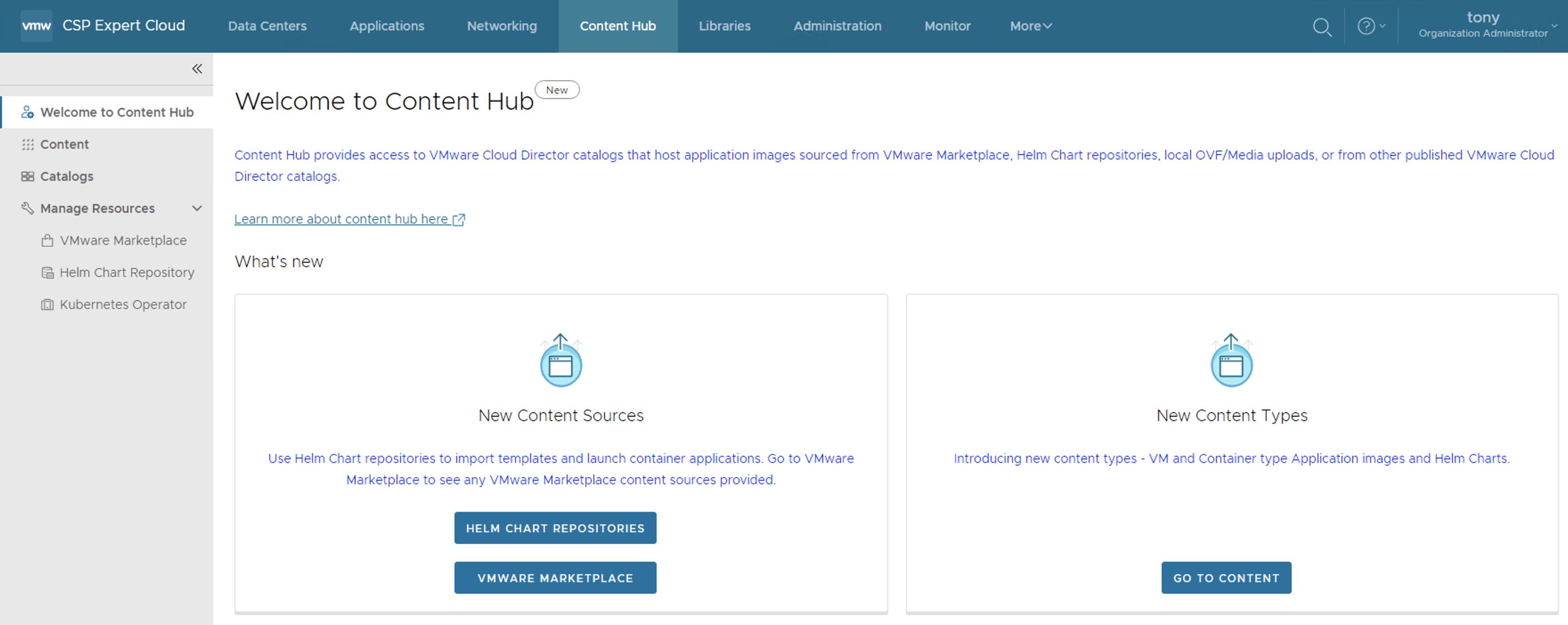
In today’s fast-paced digital landscape, businesses require agile and scalable solutions to deploy and manage their applications efficiently. VMware Cloud Director Content Hub (VDCH) introduced in VMware Cloud Director 10.5, offers a robust platform for a simplified and automated way to deploy, run, and manage a wide range of applications. In this blog, we’ll explore the key features and benefits of VMware Cloud Director Content Hub and how it streamlines the application deployment process.
What is Content Hub ?
Content Hub, introduced in VMware Cloud Director 10.5, serves as a convenient tool that unifies the interface for accessing both VM and container-based content. This feature seamlessly integrates external content sources, such as VMware Marketplace and Helmchart Repositories, into the VMware Cloud Director environment.
By incorporating external sources, content can be seamlessly brought into the catalogs of VMware Cloud Director, ensuring its immediate availability for users. With the integration of Content Hub, VMware Cloud Director introduces an interface oriented towards applications, enabling users to effortlessly visualize and retrieve catalog content, thus elevating the overall content management experience.
As a result of these enhancements, catalog items are presented as “Application Images,” highlighting crucial application information like the application’s name, version, logo, screenshots, and other pertinent details necessary for the consumption of the application
Integration with VMware Marketplace
To integrate Marketplace with VMware Cloud Director, a Cloud Provider needs to create a Marketplace Connection and then share it with one or more tenant organisations. Here is the procedure:
Cloud Provider must be logged in as a system administrator.
Cloud Provider must have access to VMware Marketplace and there generated an API token. (see Generate API Tokens in the VMware Cloud Services Product Documentation)
From the left panel, select VMware Marketplace & Click New.
The New VMware Marketplace dialog opens, and there enter the following values:
The API token ID of a valid VMware Marketplace token.
Integration with Helm Chart Repository
A Helm chart repository is a named resource that stores all the information required to establish a connection with a Helm chart repository, allows users to browse contents from a remote repository, and imports applications from the repository.
Cloud Providers and tenants both can create Helm chart repository content connections. Tenants need special RIGHTs that providers can assign to specific tenants based on requirements.
From the left panel, select Helm Chart Repository& Click New.
The New Helm Chart Repository dialog opens, and there enter the following values:
Name
Some Meaning Full Name
URL
URL of Helm chart repository
Authentication Type
Anonymous Basic
Password-protected Helm chart repositories are also supported.
You can create multiple Helm chart repository resources in VMware Cloud Director.
Share a VMware Marketplace/Helm Chart Repository Resource with tenants
As a service provider administrator, you can share the configured VMware Marketplace resources with other tenant organizations.
Inside VMware Marketplace/Helm Chat Repository, on the left of the name of the connection that you want to share, click the vertical ellipsis and select Share.
Share the resource.
Select the tenant organizations you want to share the resource with.
You can set the individual access level for the respective tenant organization only as Read Only.
Click Save.
NOTE: Since vCD does a DB caching of the helm chart repository items in vCD DB, you can click on Sync which will ensure the latest from the remote repository is cached in vCD DB.
Roles Required
A new set of User Roles has been introduced to facilitate users in accessing and managing the Content Hub. Assigning the appropriate user roles to individuals within the organization to grant them access and utilize the Content Hub feature effectively is crucial.
Right Bundles: A Rights Bundle is a collection of rights for the tenant organization and A Rights Bundle defines what a tenant organization has access to. Rights Bundles are always defined globally, and they can be applied to zero or more tenants.
Roles: A Role is a collection of rights for a user. A Role defines what an individual user has access to. Roles can either be tenant-specific–defined within a single organization and only visible to that organization, or global–defined globally and applied to zero or more tenants.
Putting all the pieces together looks something like this:
Following are the new RIGHTs introduced to manage CatalogContentSource entities:
View the Content Hub External Source
view “CatalogContentSource” entities
View Content Hub External SourceACL
view ACLs on “CatalogContentSource” entity
Change the Owner of the Content Hub External Source
change ownership of “CatalogContentSource” entity
Delete the External Source from Content Hub
To allow deletion of “CatalogContentSource” entity
Edit the External Source in Content Hub
To allow the creation/edit of “CatalogContentSource” entity NOTE – Tenants will not be allowed to create Marketplace type even with this RIGHT
Share the Content Hub External Source
To allow sharing of CatalogContentSource. NOTE – Only Cloud Provider can share across tenants. Tenants can only share among users.
Apply the Above Rights for organizations as well as the user, so that they have enough rights to add and deploy applications.
Content Hub Operator for Kubernetes Container Service Extention
To perform this operation, First, you need full control of the Kubernetes cluster, where you are deploying the container applications, and additionally the following VMware Cloud Director rights:
You must install a Kubernetes operator to allow tenant users to deploy container applications from external content sources. From the top navigation bar, select Content Hub, from the left panel, select Kubernetes Operator, and on the Kubernetes Operator page, select the Kubernetes cluster on which you want to install the Kubernetes operator, and click Install Operator.
The Install operator oncluster-name dialog opens, on this page Configure the source location of the Kubernetes operator package.
Select the type of source location for the Kubernetes operator package. VMware Registry location with anonymous access is selected by default.
(Optional) To configure a custom registry, first, you must clone the Content Hub Kubernetes operator package from the VMware container registry to your custom registry. The Content Hub Kubernetes operator package is in Carvel format and you must use the Carvel imgpkg tool for cloning the package.
Click Install Operator.
After a Few minutes it shows “Not Reachable”
And then finally it turns to “ready”, basically After the installation of the operator completes successfully, the system creates two namespaces under the Kubernetes cluster. In the first namespace, “vcd-contenthub-system”, the Content Hub Operator manager is installed. The second namespace, “vcd-contenthub-workloads”, is empty. This namespace is used to deploy container applications at a later stage.
Catalog Versioning
In the previous version of VMware Cloud Director, there was no concept of versioning in catalogs. For instance, when a user imports multiple versions of the same application from external sources into the catalog, each version of the VM or container will be stored and represented (listed) as an individual resource, but from VMware Cloud Director 10.5 onwards, a Virtual Machine application or Container application that was imported with multiple versions either at the same time or at different intervals, Content Hub is capable of managing and structure the versioning of that resource.
Let’s Deploy a Container Application
Upon launching an application image that has multiple versions, you will be prompted to choose the specific version of the image you wish to deploy.
If the Container application is launched, then the Container Application launcher window will open and then you need to provide the application Name, select the version to deploy and select the TKG Cluster.
(Optional) To customize the application parameters, click Show Advanced Settings.
Click Launch Application.
The system deploys the container application. After the deploy operation completes, on the card for the application, the status appears as Deployed. VMware Cloud Director deploys the container application as a Helm release under the vcd-contenthub-workloads namespace to the Kubernetes cluster.
Either clicking on Application Name or DETAILS, it takes user to details of the application, like Status, Pods Status, Access URLs etc..
User can use the access URL details to access the application easily
Deploy an Stateful Container Application
In this section we will deploy Casandra database using Cloud Director Content Hub, process is simple as we followed in above section, once deployed the application, check the details, here details are different like no access URL, it also created required Persistent Volumes automatically
it also give visibility to Stateful Set and its status, secrets if any, services and its type as well as other resources. this allow end user to not to check in K8s clusters vs this info is available in vCD GUI.
Deploy an Virtual Machine Application
A vApp consists of one or more virtual machines that communicate over a network and use resources and services in a deployed environment. A vApp can contain multiple virtual machines.If you have access to a catalog, you can use the vApp templates in the catalog to create vApps.
A vApp template can be based on an OVF file with properties for customizing the virtual machines of the vApp. The vApp inherits these properties. If any of those properties are user-configurable, you can specify their values.
Enter a name and, optionally, a description for the vApp.
Enter a runtime lease and a storage lease for the vApp, and click Next.
From the Storage Policy drop-down menu, select a storage policy for each of the virtual machines in the vApp, and click Next.
If the placement policies and the sizing policies for the virtual machines in the vApp are configurable, select a policy for each virtual machine from the drop-down menu.
If the hardware properties of the virtual machines in the vApp are configurable, customize the size of the virtual machine hard disks and click Next.
If the networking properties of the virtual machines in the vApp are configurable, customize them and click Next.
On the Configure Networking page, select the networks to which you want each virtual machine to connect.
(Optional) Select the check box to switch to the advanced networking workflow and configure additional network settings for the virtual machines in the vApp.
Review the vApp settings and click Finish.
You can see under Applications -> Virtual Applications, VM is getting deployed.
With Content Hub feature provide can offers centralized content management for application images, vApp and VM templates, and media. VMware Cloud Director now has full control over the deployed and listed images, storing all pertinent information in its database. Unlike the application images imported from App Launchpad, where VMware Cloud Director only listed the imported images and App Launchpad stored all the details and information in its own database as well as It offers ease of use since you won’t have to set up and configure App Launchpad, which would otherwise be an additional task.
In today’s fast-paced digital landscape, organizations are constantly seeking ways to optimize their IT operations and streamline infrastructure management. One approach that has gained significant traction is Infrastructure as Code (IaC). By treating infrastructure provisioning and management as code, IaC enables organizations to automate and standardize their processes, resulting in increased efficiency, scalability, and consistency.
In this blog article, we will explore the concept of Infrastructure as Code and its practical implementation using VMware Cloud Director. We will delve into the benefits and challenges of adopting IaC, highlight the features of VMware Cloud Director, and showcase how the integration of Terraform with VMware Cloud Director can revolutionize IT operations for Cloud Providers as well as customers.
What is Infrastructure as Code?
Infrastructure as Code (IaC) is a methodology that involves defining and managing infrastructure resources programmatically using code. It allows organizations to provision, configure, and manage their infrastructure resources, such as compute, network, and storage, through automated processes. By treating infrastructure as code, organizations can leverage the same software development practices, such as version control and continuous integration, to manage their infrastructure.
Benefits of Infrastructure as Code
The adoption of Infrastructure as Code brings numerous benefits to cloud providers as well as customers:
Consistency and repeatability: With IaC, infrastructure deployments become consistent and repeatable, ensuring that the same configuration is applied across different environments. This eliminates configuration drift and minimizes the risk of errors caused by manual configurations.
Efficiency and scalability: IaC enables organizations to automate their infrastructure provisioning and management processes, reducing the time and effort required for manual tasks. This allows IT teams to focus on more strategic initiatives and scale their infrastructure easily as the business demands.
Version control and collaboration: By using code repositories and version control systems, organizations can track changes made to their infrastructure configurations, roll back to previous versions if needed, and collaborate effectively across teams.
Documentation and auditability: IaC provides a clear and documented view of the infrastructure configuration, making it easier to understand the current state and history of the infrastructure. This improves auditability and compliance with regulatory requirements.
Flexibility and portability: With IaC, organizations can define their infrastructure configurations in a platform-agnostic manner, making it easier to switch between different cloud providers or on-premises environments. This provides flexibility and avoids vendor lock-in.
Challenges of Infrastructure as Code
While Infrastructure as Code offers numerous advantages, it also presents some challenges that organizations should be aware of:
Learning curve: Adopting IaC requires IT teams to acquire new skills and learn programming languages or specific tools. This initial learning curve may slow down the adoption process and require investment in training and upskilling.
Code complexity: Infrastructure code can become complex, especially for large-scale deployments. Managing and troubleshooting complex codebases can be challenging and may require additional expertise or code review processes.
Continuous maintenance: Infrastructure code needs to be continuously maintained and updated to keep up with evolving business requirements, security patches, and technology advancements. This requires ongoing investment in code management and testing processes.
Infrastructure as Code Tools
There are various tools available in the market to implement Infrastructure as Code. Some of the popular ones include:
Terraform: Terraform is an open-source tool that allows you to define and provision infrastructure resources using declarative configuration files. It supports a wide range of cloud providers, including VMware Cloud Director, and provides a consistent workflow for infrastructure management.
Chef: Chef is a powerful automation platform that enables you to define and manage infrastructure as code. It focuses on configuration management and provides a scalable solution for infrastructure provisioning and application deployment.
Puppet: Puppet is a configuration management tool that helps you define and automate infrastructure configurations. It provides a declarative language to describe the desired state of your infrastructure and ensures that the actual state matches the desired state.
Ansible: Ansible is an open-source automation tool that allows you to define and orchestrate infrastructure configurations using simple, human-readable YAML files. It emphasizes simplicity and ease of use, making it a popular choice for infrastructure automation.
VMware Cloud Service Provider Program
The VMware Cloud Service Provider Program (CSP) allows service providers to build and operate their own cloud environments using VMware’s virtualization and cloud infrastructure technologies like VMware Cloud Director, Cloud Director availability etc… This program enables service providers to offer a wide range of cloud services, including infrastructure-as-a-service (IaaS), disaster recovery, Application as a Service, Kubernetes as a Service, DBaaS and many other managed services.
Integrating Terraform with VMware Cloud Director
To leverage the power of Infrastructure as Code in VMware Cloud Director, you can integrate it with Terraform. Terraform provides a declarative language for defining infrastructure configurations and a consistent workflow for provisioning and managing resources across different cloud providers, including VMware Cloud Director. By combining Terraform with VMware Cloud Director, Cloud Providers/Customers can:
Automate infrastructure provisioning: With Terraform, Cloud providers can define Tenant virtual data center, virtual machines, networks, and other resources as code. This allows for automated and consistent provisioning of infrastructure resources, eliminating manual configuration. I wrote a blog article on how to start with Cloud Director & Terraform which can be found here:
Ensure consistency and repeatability: Infrastructure configurations defined in Terraform files can be version controlled, allowing for easy tracking of changes and ensuring consistency across different environments.
Collaborate effectively: Terraform code can be shared and collaboratively developed within teams, enabling better collaboration and knowledge sharing among IT professionals.
Enable infrastructure as self-service: By integrating Terraform with VMware Cloud Director, organizations can provide a self-service portal for users to provision and manage their own infrastructure resources, reducing dependency on IT support.
Implementing Infrastructure as Code with VMware Cloud Director and Terraform
To begin with the Terraform configuration, create a main.tf file and specify the version of the VMware Cloud Director Terraform provider
In the above configuration, replace the url, user, password, org, and vdc values with your own VMware Cloud Director details.Now, let’s define the infrastructure resources using Terraform code. Here’s an example of creating a organization in VMware Cloud Director:
#Create a new org name "tfcloud"
resource "vcd_org" "tfcloud" {
  name              = "terraform_cloud"
  full_name         = "Org created by Terraform"
  is_enabled        = "true"
  stored_vm_quota   = 50
  deployed_vm_quota = 50
  delete_force      = "true"
  delete_recursive  = "true"
  vapp_lease {
    maximum_runtime_lease_in_sec          = 0
    power_off_on_runtime_lease_expiration = false
    maximum_storage_lease_in_sec          = 0
    delete_on_storage_lease_expiration    = false
  }
  vapp_template_lease {
    maximum_storage_lease_in_sec       = 0
    delete_on_storage_lease_expiration = false
  }
}
Best Practices for Infrastructure as Code with VMware Cloud Director
Implementing Infrastructure as Code with VMware Cloud Director and Terraform requires adherence to best practices to ensure efficient and reliable deployments. Here are some key best practices to consider:
Use version control: Store your Terraform code in a version control system such as Git to track changes, collaborate with teammates, and easily roll back to previous configurations if needed.
Leverage modules: Use Terraform modules to modularize your infrastructure code and promote reusability. Modules allow you to encapsulate and share common configurations, making it easier to manage and scale your infrastructure.
Implement testing and validation: Create automated tests and validations for your infrastructure code to catch any potential errors or misconfigurations before deployment. This helps ensure the reliability and stability of your infrastructure.
Implement a CI/CD pipeline: Integrate your Terraform code with a continuous integration and continuous deployment (CI/CD) pipeline to automate the testing, deployment, and management of your infrastructure. This helps in maintaining consistency and enables faster and more reliable deployments.
Use variables and parameterization: Leverage Terraform variables and parameterization techniques to make your infrastructure code more flexible and reusable. This allows you to easily customize your deployments for different environments or configurations.
Implement security best practices: Follow security best practices when defining your infrastructure code. This includes managing access controls, encrypting sensitive data, and regularly updating your infrastructure to address any security vulnerabilities.
Conclusion
Infrastructure as Code offers a transformative approach to managing infrastructure resources, enabling organizations to automate and streamline their IT operations. By integrating Terraform with VMware Cloud Director, organizations can leverage the power of Infrastructure as Code to provision, manage, and scale their infrastructure efficiently and consistently.
In this blog post, we explored the concept of Infrastructure as Code, the benefits and challenges associated with its adoption. We also provided a step-by-step guide on implementing Infrastructure as Code with VMware Cloud Director using Terraform, along with best practices.
By embracing Infrastructure as Code, Cloud providers and their Tenants can unlock the full potential of their infrastructure resources, accelerate their digital transformation journey, and ensure agility, scalability, and reliability in their IT operations.
In the ever-evolving landscape of cloud technology, Cloud Service Providers (CSPs) play a crucial role in helping businesses unlock the potential of their data. Database as a Service (DBaaS) offerings have become essential tools for organizations looking to streamline their data management processes. This article will explore how our CSP is revolutionizing DBaaS with Cloud Director Data Solutions, powered by VMware SQL with MySQL. Discover how this powerful combination can transform CSP and customers’ data management experience.
VMware Cloud Director Extension for Data Solutions: An Introduction
The VMware Cloud Director Extension for Data Solutions is a game-changing plug-in for the VMware Cloud Director. By incorporating data and messaging services into the VMware Cloud Director portfolio, it enables cloud providers and their tenants to access and manage services such as VMware SQL with MySQL, VMware SQL with PostgreSQL, and the efficient messaging system, RabbitMQ.
The extension operates in conjunction with Container Service Extension 4.0 or later, facilitating the publication of popular data and messaging services to tenants. These services are deployed in a Tanzu Kubernetes Grid Cluster, which is managed by Container Service Extension 4.0 or later. This powerful combination simplifies the process of deploying and managing these services, while also offering data analytics and monitoring through Grafana and Prometheus.
How the VMware Cloud Director Extension for Data Solutions Functions
The VMware Cloud Director Extension for Data Solutions works hand-in-hand with the Container Service Extension 4.x to provide cloud providers with the ability to publish data and messaging services to their tenants. In turn, tenants can utilize these services for building new applications or maintaining existing ones.
Services are deployed within a Tanzu Kubernetes Grid Cluster, which is managed by the Container Service Extension 4.0 or later. This plays a crucial role in the deployment of services, with a service operator installed in a selected tenant Tanzu Kubernetes Cluster responsible for managing the entire lifecycle of a service, from inception to dissolution.
To better understand the architecture of the VMware Cloud Director Extension for Data Solutions, consider the high-level diagram provided below.
Use Cases for the VMware Cloud Director Extension for Data Solutions
Tenants can utilize the VMware Cloud Director Extension for Data Solutions for various purposes, such as creating database and messaging services at scale. Once these services are available in a tenant organization, authorized tenant users can create, upgrade, or delete PostgreSQL, MySQL, or RabbitMQ services. Advanced settings, such as enabling High Availability for VMware SQL with MySQL and VMware SQL with PostgreSQL, can be applied during the creation of a service.
In addition to creating database and messaging services, tenants can effortlessly manage their upgrades. When a newer version becomes available, the VMware Cloud Director Extension for Data Solutions interface will notify the user and prompt them to take action. Tenant administrators or users can then upgrade the chosen service with a single click, safeguarding the service against vulnerabilities and ensuring its stability.
Tenant self-service UI for the lifecycle management of VMware SQL with MySQL
Step:1 – Installing VMware Cloud Director Data Solutions operator
To run VMware SQL with MySQL in a Kubernetes cluster using the VMware Cloud Director extension for Data Solutions, you must install a VMware Cloud Director extension for the Data Solutions operator to a Kubernetes cluster. The VMware Cloud Director Data Solutions operator (DSO) is a backend service running within each tenant Kubernetes cluster. DSO manages the lifecycle of user resources in Kubernetes clusters upon user requests, sent through VMware Cloud Director Resource Defined Entities. The resources include both data solution operators like VMware RabbitMQ operators for Kubernetes and data solution instances like VMware RabbitMQ for Kubernetes. It deploys, upgrades, and updates various data solutions in Kubernetes clusters on behalf of the user.
Log in to VMware Cloud Director extension for Data Solutions from VMware Cloud Director.
Click Settings > Kubernetes Clusters.
Select the Kubernetes cluster where you want to run VMware Cloud Director extension for Data Solutions, and click Install Operator.
It takes a few minutes for the Operator Status of the cluster to change to Active.
Step:2 – Installing VMware SQL with MySQL
Log in to VMware Cloud Director extension for Data Solutions from VMware Cloud Director.
Click Instances > New Instance.
Enter the necessary details.
Enter the instance name.
Select the solution, for which you want to create an instance.
Select the Kubernetes cluster for this instance.
you must enter only a default passwordSelect a sizing template for this instance.
To customize more details click Show Advanced Settings
To connect to a MySQL instance from outside of your Kubernetes cluster, we must configure the Kubernetes service for the instance to be of type “Load Balancer”. Select “Expose Service by Load Balancer”
Click Create.
You can also track the progress of the deployment by running:
#kubectl get pods -n vcd-ds-workloads
After a few minutes, you should see MySQL status is “Running” in vCD GUI as well
You can continue to see progress in the vCD taskbar as well as the Monitor section of vCD GUI, it is automatically creating required persistent volumes as well as Network services like Load Balancer and NAT rules
Kubernetes will request and Cloud Director then allocate an external IP address (load balancer IP) to the service, which we can use to connect to the MySQL service from outside the cluster. You can view the Load Balancer IP by running:
#kubectl get svc -A
Take note of the External IP, which in this case is 172.16.2.6, we will use this IP to connect to the MySQL cluster from outside
Step:3 – Connecting to VMware SQL with MySQL
To connect to a MySQL service using Workbench, you can follow these steps:
Download and install MySQL Workbench from the official MySQL website if you haven’t already.
Launch MySQL Workbench on your computer.
In the Workbench home screen, click on the “+” icon next to “MySQL Connections” to create a new connection.
In the “Setup New Connection” dialog, enter a connection name of your choice.
Configure the following settings:
1-Connection Method: Standard TCP/IP
2-MySQL Hostname: External IP address of the MySQL server.in this case is 172.16.2.6
3-MySQL Server Port: Enter the port number(default is 3306).
4-Username: Enter the MySQL username as “mysqlappuser”
5-Password: Enter the MySQL password as you entered while deploying MySQL
Click on the “Test Connection” button to check if the connection is successful. If the test is successful, you should see a success message.
Click on the “OK” button to save the connection settings.
After following these steps, you should be connected to your MySQL service using MySQL Workbench. You can then use the Workbench interface to view this newly deployed instance, run queries, and perform various read-only database-related tasks, because:
When Tenant creates a MySQL deployment through VMware Cloud Director for Data Solutions extension, the MySQL instance gets a default DB user named “mysqlappuser”, This “mysqlappuser” user’s privilege is limited to the default DB instance.“mysqlappuser” user does not have enough permission to create a database, we need to create a new user which has enough permissions to create a database.
Step:4 – Enable a full-privileged DB user for your MySQL instance provisioned by the VMware Cloud Director Extension for Data Solutions
MySQL by default has a built-in “root” user with administrator privilege in every MySQL deployment, but it doesn’t support external access. We will use this user to create another full-privileged DB user.
Find DB root user’s password by using below commands:
# kubectl get secret -n vcd-ds-workloads
#kubectl get secret mysqldb01-credentials -n vcd-ds-workloads -o jsonpath='{.data}'
Take note of “rootPassword” from the output of the above command and copy the full encrypted password, which in this case starts with “RE1n**********”
Decode the above “rootPassword” using below command
Now run the below command to connect to the MySQL instance:
1 - Login to SQL
      #mysql -u root -p$ADMIN_PASSWORD -h 127.0.0.1 -P 3306
2 - Enter decoded password, once you successfully connected to the MySQL
3 - Create a local MySQL user using:
      #CREATE USER 'user01'@'%' IDENTIFIED BY 'password';
      #GRANT ALL PRIVILEGES ON * . * TO 'user01'@'%';
That’s it, now we can connect to this SQL Instance and can create a new database as you can see below screenshot
NOTE: Thanks to the writer of this blog, https://realpars.com/mysql/, I am using this database for this blog article.
In Summary, by leveraging VMware Cloud Director Extension for Data Solutions, CSPs can unlock the power of DBaaS using VMware SQL with MySQL, offering customers a comprehensive and efficient platform for their data management needs. With simplified deployment and management, seamless scalability, enhanced performance optimization, high availability, and robust security and compliance features, CSPs can provide businesses with a reliable and scalable DBaaS solution. Embrace the potential of DBaaS with VMware Cloud Director Extension for Data Solutions and VMware SQL with MySQL, and empower your customers with streamlined data management capabilities in the cloud.
VMware vRealize (ARIA) Operations Compliance Pack for Sovereign Cloud is a management pack available in the VMware Marketplace. You can download and install this management pack on an instance of vRealize (ARIA) Operations to automatically assess a Sovereign Cloud stack for compliance.
VMware vRealize (ARIA) Operations Compliance Pack for Sovereign Cloud is intended to be used by the VMware Cloud Service Partners who are part of the Sovereign Cloud Initiative. The following products in the Sovereign Cloud stack are currently supported for compliance assessment:
vSphere
NSX-T
VMware Cloud Director
VMware Cloud Director Availability
For every Sovereign Cloud instance, providers need one instance of vRealize (ARIA) Operations with the VMware vRealize (ARIA) Operations Compliance Pack for Sovereign Cloud installed and configured. The compliance score card is available in the Optimize > Compliance screen of vRealize (ARIA) Operations.
Compliance Pack for Sovereign Cloud Controls Rules
The compliance rules are based on a checklist that VMware vRealize (ARIA) Operations Compliance Pack for Sovereign Cloud utilizes to monitor the products in the Sovereign Cloud stack. The checklist is based on the Sovereign Cloud Framework which takes into consideration the following key principles:
Data Sovereignty and Jurisdictional Control
Data should reside locally.
The cloud should be managed and governed locally, and all data processing including API calls should happen within the country/geography.
Data should be accessible only to residents of the same country, and the data should not be accessible under foreign laws or from any outside geography.
Data Access and Integrity
Two data center locations.
File, Block, and Object store options
Backup services, Disaster Recovery
Low-latency connectivity, Micro segmentation
Data Security and Compliance
Industry recognized Security Controls (minimum ISO/IEC 27001 or equivalent)
Additional relevant industry or governmental certifications
Third-party audits & Zero Trust Security & Encryption
Catalog of trusted images using the sovereign repository
Support for air gapped zones/regions
Operating personnel requirements and security clearance
Data Independence and Interoperability
Workload migration with bi-directional workload portability
Modern application architecture using containers
Support for hybrid cloud deployments
Control Rules and Product Control Set for vSphere
The vSphere control set is available for version 7, and 6.5/6.7 separately and details can be Here
Control Rules and product control set for nsx-t
Control rules and product control set for NSX-T and details can be found Here. The NSX-T version supported is greater than or equal to 3.2.x.
Controls Rules and Product Control Set for VMware Cloud Director
Control rules and product control set for VMware Cloud Director and details can be found Here. The supported version of the VMware Cloud Directory management pack is 8.10.2.
Control Rules and Product Control Set for VMware Cloud Director Availability
Controls rules and product control set for VMware Cloud Director Availability and details can be found Here. The version of the VMware Cloud Director Availability management pack supported is 1.2.1.
Install the VMware vRealize (ARIA) Operations Compliance Pack for Sovereign Cloud
The VMware vRealize (ARIA) Operations Compliance Pack for Sovereign Cloud consists of a PAK file that contains default contains views, reports, alerts and symptoms for the VMware software in the Sovereign Cloud stack.
Download the PAK file for VMware vRealize Operations Compliance Pack for Sovereign Cloud from the VMware Marketplace, and save the file to a temporary folder on your local system.
Log in to the vRealize (ARIA) Operations user interface with administrator privileges. Installation of this management pack is to be done by VMware Cloud Provider Program Partners.
In the left pane of vRealize (ARIA) Operations, click Integrations under Data Sources.
In the Repository tab, click the ADD button.
The Add Solution dialog box opens , Click BROWSE to locate the temporary folder on your system, and select the PAK file.
Read and select the checkboxes if required, Click Upload. The upload might take several minutes
Read and accept the EULA, and click Next. Installation details appear in the window during the process.
When the installation is completed, click Finish.
in the vROps instance, go to Optimize > Compliance. In the VMware Cloud tab, you can see the VMware Sovereign Cloud Compliance card in the VMware Sovereign Cloud Benchmarks section. Click Enable.
When you click Enable, a list of policies appears. You must select a policy that you want to apply. i am selecting default policy here
With the vRealize (ARIA) Operations reporting functions, you can generate a report to view the compliance status of your Sovereign Cloud. You can download the report in a PDF or CSV file format for future and offline needs.
Accessing Compliance Reports
In the VMware vRealize (ARIA) Operations Compliance Pack for Sovereign Cloud two kinds of reports are available:
At a VMware Cloud Provider Program Partner level – This report considers all the infrastructure level resources and generates a report at the org level, showing non-compliance. The compliance data is for the org and associated child hierarchy. Includes compliance details for org, org-vdc, virtual machines, logical switches, and logical routers as per the hierarchy.
From the left menu, click Visualize > Reports and run the report – [vCloud Director] – VMware Sovereign Cloud – Non-Compliance Report.
From the Reports panel, click Generated Reports, To select a generated report from the list, click the vertical ellipsis against the [vCloud Director] – VMware Sovereign Cloud – Non-Compliance Report report and select options such as run and delete.
At a tenant level – The VMware Cloud Provider Program Partner generates a filtered report that the tenant can access. This report is at an org-VDC level. The compliance data is for the child hierarchy only. Includes compliance details for virtual machines, logical switches, and logical routers as per the hierarchy and Tenants can view the generated reports in the VMware Chargeback console by logging in and navigating to Reports > Tenant Reports and clicking the Generated Reports tab.
Custom Benchmarks
In case the CSP partner/customer requires they can create a custom compliance benchmark to ensure that objects comply with compliance alerts available in vRealize (ARIA) Operations, or custom compliance alert definitions. When a compliance alert is triggered on your vCenter instance, hosts, virtual machines, distributed port groups, or distributed switches, you investigate the compliance violation. You can add up to five custom compliance scorecards
This is the first version of the sovereign cloud compliance pack for ARIA Operations for our Cloud Providers brings a comprehensive compliance checklist that encompasses the sovereign framework as a benchmark and continuously validates applications and infrastructure to help partners maintain their sovereignty posture. This brings extended capabilities to ARIA Operations, which, now addition to the capacity, cost, and performance monitoring, will monitor and report compliance drifts to the right stakeholders to better manage their compliance structure.
This post explains how to install and access Tanzu Contour, Promethous and Grafana on Tanzu clusters deployed by Cloud Director Container Service extension. so to get started first ensure TANZU CLI is installed on your local machine, if not then you can install by following documentation given Here
Next thing you need is the kubeconfig file of your target TKG cluster which is reachable from your local client machine on which you have installed Tanzu CLI, also make sure you run:
# tanzu init
Installation Steps
NOTE: CSE4 provisioned TKG cluster, cert-manager, kapp-controller, secretgren-controller and tanzu-standard package repository already have been installed. so you can skip step1,2 and 3.
Step:1- Install kapp-controller
kapp-controller gives us a flexible way to fetch, template, and deploy our applications to Kubernetes. It will also keep our apps continuously up to date when the configuration in our source repository changes. Install kapp-controller in the cluster using:
In order to manage secrets across namespaces, Tanzu utilizes the carvel secret-gen-controller. you can install secretgren-controller in the cluster using:
Using the Tanzu CLI, you can install packages from the built-in tanzu-standard package repository or from other package repositories that you add to your target cluster, such as the Tanzu Application Platform Repository. Install tanzu-standard package repository v1.6.0.
Verify that the Prometheus package is available in your Tanzu K8s cluster as well as retrieve the version of the available package:
#tanzu package available list prometheus.tanzu.vmware.com -A
Verify that the Contour package is available in your Tanzu K8s cluster as well as retrieve the version of the available package:
#tanzu package available list contour.tanzu.vmware.com -A
verify that the Grafana package is available in your Tanzu K8s cluster as well as retrieve the version of the available package:
#tanzu package available list grafana.tanzu.vmware.com -A
Step4:- Implement Ingress Control with Contour
Contour is a Kubernetes ingress controller that uses the Envoy edge and service proxy. Tanzu Kubernetes Grid includes signed binaries for Contour and Envoy, which you can deploy into Tanzu Kubernetes (workload) clusters to provide ingress control services in those clusters.
You must first create the configuration file that will be used when you install the Contour package and then install the package. you can generate config file using:
#tanzu package available get contour.tanzu.vmware.com/1.20.2+vmware.1-tkg.1 --values-schema

#tanzu package available get contour.tanzu.vmware.com/PACKAGE-VERSION -generate-default-values-file
I am using below using data-values.yaml for contour
Prometheus is an open-source systems monitoring and alerting toolkit. Tanzu Kubernetes Grid includes signed binaries for Prometheus that you can deploy on workload clusters to monitor cluster health and services.verify the configuration file using below commands, this file configures the Prometheus package.
#tanzu package available get prometheus.tanzu.vmware.com/2.36.2+vmware.1-tkg.1 --values-schema
#tanzu package available get prometheus.tanzu.vmware.com/PACKAGE-VERSION --generate-default-values-file
This command lists configuration parameters of the Grafana package and their default values. You can use the output to update your prometheus-data-values.yaml file, I have used below config file which is hosted on git, if you want you can download and use and in my config file ingress is enabled in the yaml which means it works with ingress.
Grafana is open-source software that allows you to visualize and analyze metrics data collected by Prometheus on your clusters. Tanzu Kubernetes Grid includes a Grafana package that you can deploy on your Tanzu Kubernetes clusters. verify the configuration file, this file configures the Grafana package..
#tanzu package available get grafana.tanzu.vmware.com/7.5.16+vmware.1-tkg.1 --values-schema

##tanzu package available get grafana.tanzu.vmware.com/PACKAGE-VERSION --generate-default-values-file
This command lists configuration parameters of the Grafana package and their default values. You can use the output to update your grafana-data-values.yml file, I have used below config file which is hosted on git, if you want you can download and use and in my config file ingress is enabled in the yaml which means it works with ingress.
After Grafana is deployed, the grafana package creates a Contour HTTPProxy object with a Fully Qualified Domain Name (FQDN) of grafana.system.tanzu. To use this FQDN to access the Grafana dashboard, Use the IP address of the LoadBalancer for the Envoy service in the tanzu-system-ingress namespace.
In case FQDN to access the Grafana dashboard does not work
Create an entry in your local /etc/hosts file that points an IP address to this FQDN:
Use the IP address of the LoadBalancer for the Envoy service in the tanzu-system-ingress namespace.
Navigate to https://grafana.system.tanzu.
Another issue is because the site uses self-signed certificates, you might need to navigate through a browser-specific security warning before you are able to access the dashboard.
VMware Cloud Director Container Service Extension brings Kubernetes as a service to VMware Cloud Director, offering multi-tenant, VMware supported, production ready, and compatible Kubernetes services with Tanzu Kubernetes Grid. As a service provider administrator, you can add the service to your existing VMware Cloud Director tenants. By using VMware Cloud Director Container Service Extension, customers can also use Tanzu products and services such as Tanzu® Mission Control to manage their clusters.
Pre-requisite for Container Service Extension 4.0
Provider Specific Organization – Before you can configure VMware Cloud Director Container Service Extension server, it is must to create an organization to hosts VMware Cloud Director Container Service Extension server
Organization VDC within Organization – Container Service extension Appliance will be deployed in this organization virtual data center
Network connectivity – Network connectivity between the machine where VMware Cloud Director Container Service Extension is installed, and the VMware Cloud Director server. VMware Cloud Director Container Service Extension communicates with VMware Cloud Director using VMware Cloud Director public API endpoint
CSE 4.0 CPI automatically creates Load balancer, you must ensure that you have configured NSX Advanced Load Balancer, NSX Cloud, and NSX Advanced Load Balancer Service Engine Group for tenants who need to create Tanzu Kubernetes Cluster.
Provider Configuration
With the release of VMware Cloud Director Container Service Extension 4.0, service providers can use the CSE Management tab in the Kubernetes Container Clusters UI plug-in, which demonstrate step by step process to configure the VMware Cloud Director Container Service Extension server.
Install Kubernetes Container Clusters UI plug-in for VMware Cloud Director
You can download the Kubernetes Container Clusters UI plug-in for the VMware Cloud Director Download Page and upload the plug-in to VMware Cloud Director.
NOTE: If you have previously used the Kubernetes Container Clusters plug-in with VMware Cloud Director, it is necessary to deactivate it before you can activate a newer version, as only one version of the plug-in can operate at one time in VMware Cloud Director. Once you activate a new plug-in, it is necessary to refresh your Internet browser to begin using it.
Once partner has installed plugin, The Getting Started section with in CSE Management page help providers to learn and set up VMware Cloud Director Container Service Extension in VMware Cloud Director through the Kubernetes Container Clusters UI plug-in 4.0. At very High Level this is Six Step process:
Lets start following these steps and deploy
Step:1 – This section links to the locations where providers can download the following two types of OVA files that are necessary for VMware Cloud Director Container Service Extension configuration:
Step:2 – Create a catalog in VMware Cloud Director and upload VMware Cloud Director Container Service Extension OVA files that you downloaded in the step:1 into this catalog
Step:3 – This section initiates the VMware Cloud Director Container Service Extension server configuration process. In this process, you can enter details such as software versions, proxy information, and syslog location. This workflow automatically creates a Kubernetes Clusters rights bundle, CSE Admin Role role, Kubernetes Cluster Author role, and VM sizing policies. In this process, the Kubernetes Clusters rights bundle and Kubernetes Cluster Author role are automatically published to all tenants as well as following Kubernetes resource versions will be deployed
Kubernetes Resources
Supported Versions
Cloud Provider Interface (CPI)
1.2.0
Container Storage Interface (CSI)
1.3.0
CAPVCD
1.0.0
Step:4 – This section links to the Organization VDCs section in VMware Cloud Director, where you can assign VM sizing policies to customer organization VDCs. To avoid resource limit errors in clusters, it is necessary to add Tanzu Kubernetes Grid VM sizing policies to organization virtual data centers.The Tanzu Kubernetes Grid VM sizing policies are automatically created in the previous step. Policies created are as below:
Sizing Policy
Description
Values
TKG small
Small VM sizing policy
2 CPU, 4 GB memory
TKG medium
Medium VM sizing policy
2 CPU, 8 GB memory
TKG large
Large VM sizing policy
4 CPU, 16 GB memory
TKG extra-large
X-large VM sizing policy
8 CPU, 32 GB memory
NOTE: Providers can create more policies manually based on requirement and publish to tenants
In VMware Cloud Director UI, select an organization VDC, and from the left panel, under Policies, select VM Sizing and Click Add and then from the data grid, select the Tanzu Kubernetes Grid sizing policy you want to add to the organization, and click OK.
Step:5 – This section links to the Users section in VMware Cloud Director, where you can create a user with the CSE Admin Role role. This role grants administration privileges to the user for VMware Cloud Director Container Service Extension administrative purposes. You can use this user account as OVA deployment parameters when you start the VMware Cloud Director Container Service Extension server.
Step:6 – This section links to the vApps section in VMware Cloud Director where you can create a vApp from the uploaded VMware Cloud Director Container Service Extension server OVA file to start the VMware Cloud Director Container Service Extension server.
Create a vApp from VMware Cloud Director Container Service Extension server OVA file.
Configure the VMware Cloud Director Container Service Extension server vApp deployment lease
Power on the VMware Cloud Director Container Service Extension server.
Container Service Extension OVA deployment
Enter a vApp name, optionally a description, runtime lease and storage lease (should be no lease so that it does not suspend automatically), and click Next.
Select a virtual data center and review the default configuration for resources, compute policies, hardware, networking, and edit details where necessary.
In the Custom Properties window, configure the following settings:
VCD host: VMware Cloud Director URL
CSE service account’s username The username: CSE Admin user in the organization
CSE service account’s API Token: to generate API Token, login to provider session with CSE user which you created in Step:5 and then go to “User Preferences” and click on “NEW” in “ACCESS Tokens” section (When you generate an API Access Token, you must copy the token, because it appears only once. After you click OK, you cannot retrieve this token again, you can only revoke it. )
CSE service account’s org: The organization that the user with the CSE Admin role belongs to, and that the VMware Cloud Director Container Service Extension server deploys to.
CSE service vApp’s org: Name of the provider org where CSE app will be deployed
In the Virtual Applications tab, in the bottom left of the vApp, click Actions > Power > Start. this completes the vApp creation from the VMware Cloud Director Container Service Extension server OVA file. This task is the final step for service providers to perform before the VMware Cloud Director Container Service Extension server can operate and start provisioning Tanzu Kubernetes Clusters.
CSE 4.0 is packed with capabilities that address and attract developer personas with an improved feature set and simplified cluster lifecycle management. Users can now build and upgrade versions, resize, and delete K8s clusters directly from the UI making it simpler and faster to accomplish tasks than before. This completes provider section of Container Service extension in next blog post i will write about Tenant workflow.